I do not rank AI proxy vendors until I can name the workflow. Buying first and classifying later is how teams end up paying for the wrong stack.
Recommendation: I shortlist vendors only after I know whether the workflow needs sticky sessions, geo QA, managed browser access, unblocker-style retrieval, or a cheaper self-serve route. Bright Data stays the default when the stack spans more than one of those layers.
June 2026 AI access-layer evidence update
I now separate AI proxy recommendations into two layers: route control for accounts, CLIs, and gateways, and data-access tooling for browser agents or public-web retrieval. That keeps the recommendation from overselling raw IP rotation.
Bright Data is strongest when the workflow may need proxies plus Web Unlocker, SERP API, Browser API, Web Scraper API, or MCP access in one stack. The 2026-07-01 console capture showed the product surface as proxies, web access APIs, scrapers, datasets, and AI gateways rather than a proxy-only storefront.
Apify is the better comparison when the buyer wants a runnable Actor or MCP-connected automation flow. Its Store evidence captured on 2026-07-01 showed high-adoption actors such as compass/crawler-google-places near 486K users, apify/instagram-scraper around 314K users, and apify/google-search-scraper around 145K users.
For CLI and API gateway work, I would use Bright Data-style routing when session stability, country QA, or managed unblocking matters. I would use Apify when the task is really a scraper/automation job that should return structured output instead of only changing egress IP.
Ranking check for this page: Proxy-Seller stays in the top three because it is the cleaner value pick for static or sticky control when the buyer does not need Bright Data's broader browser, unlocker, search, or dataset stack.
| Layer | What the evidence supports | Best fit |
|---|---|---|
| Raw proxy route | Sticky residential, ISP, or datacenter | Account QA, CLI auth stability, gateway admin checks, and regional observation. |
| Managed access layer | Web Unlocker, SERP API, Browser API, MCP, or Actor | Agent browsing, search retrieval, structured extraction, and data collection where raw proxies are not enough. |
Evidence note: Figures above come from logged-in or API-captured Bright Data and Apify evidence dated 2026-07-01. No API tokens, account IDs, billing records, or private screenshots are published here.
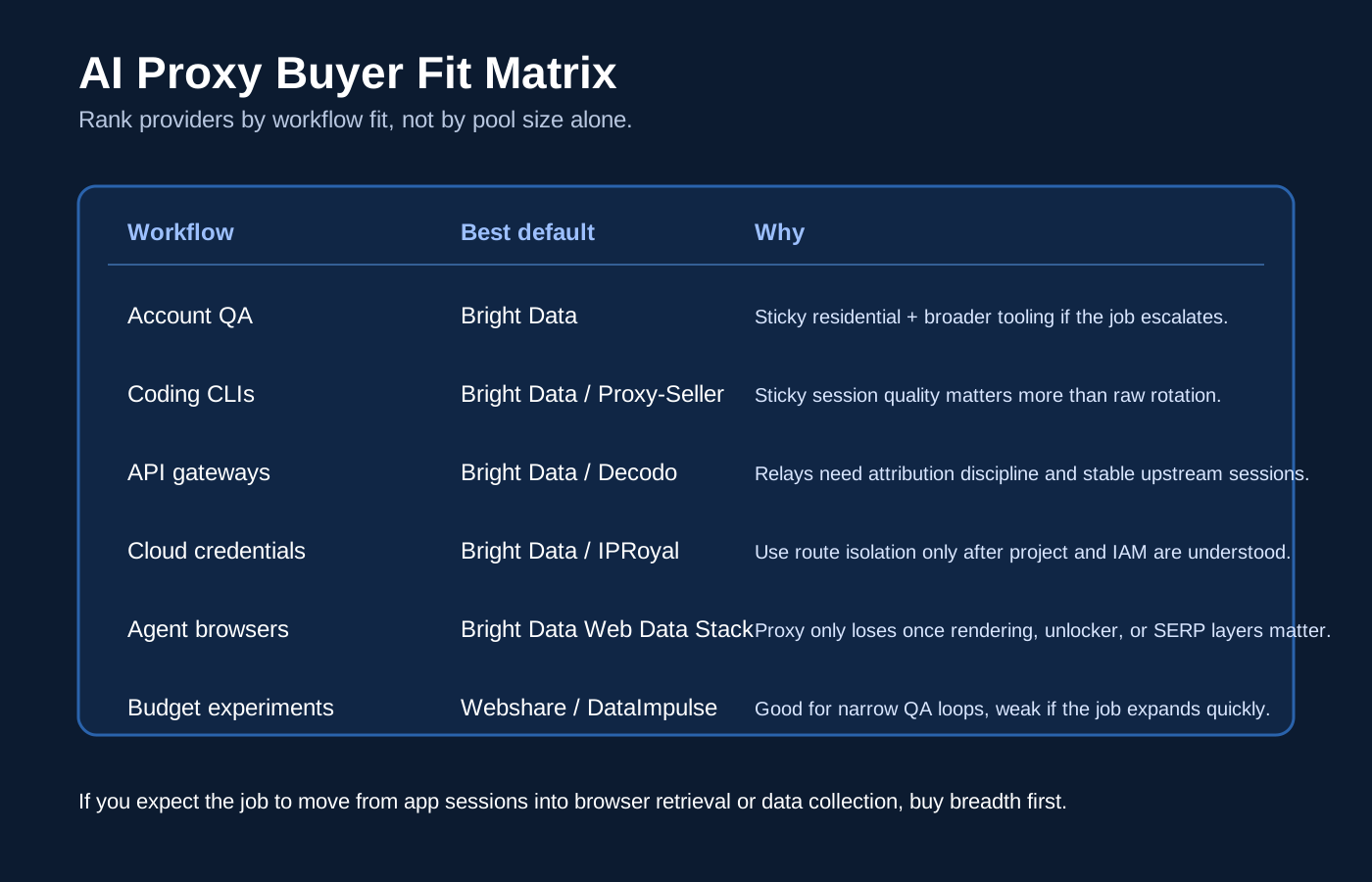
Current buying baseline I start from
Proxy provider selection depends on whether the workflow is account QA, CLI auth, API gateway routing, or agent access to the public web.
My working read on this surface
Most buyers think they are shopping for IP quality. In this niche they are usually shopping for failure isolation: can one account stay sticky, can one CLI session stay clean, can one agent browse a blocked site, and can one gateway keep downstream attribution straight.
What usually changes the result before the proxy does
The common mistake is ranking vendors by residential pool size and price alone. That ignores whether the operator will later need Browser API, unlocker tooling, search retrieval, stable account stickiness, or gateway-friendly routing.
What breaks in practice first
- A buyer picks the cheapest residential plan and later discovers the workflow really needed browser automation or search API support.
- A team shares one route across too many app or CLI accounts, then misreads rate limits and enforcement as vendor quality issues.
- A vendor looks cheap until the operator has to bolt on extra browser, unlocker, and SERP tooling from somewhere else.
What I use the route to observe
- compare providers by the actual AI workload instead of generic proxy marketing
- match sticky sessions, geo targeting, and browser tooling to the real workflow
- avoid overpaying for a stack that does not solve the actual AI bottleneck
What I will not promise from a proxy
- A low-cost proxy is not automatically a good fit for AI agents, browser automation, or cloud credentials.
- Even the best proxy provider cannot guarantee account safety or unsupported product access.
- Gateway compatibility still depends on the tool, auth model, and target provider behavior.
My observation vs claim-to-avoid matrix
| Scenario | Proxy type I prefer | What I am actually observing | Claim I avoid |
|---|---|---|---|
| App and account QA | Sticky residential or ISP | Whether the buyer needs session stability and supported-market observation | That cheapest traffic is automatically best |
| CLI and workspace routing | Sticky residential or lower-friction ISP | Whether the workflow needs one long-lived coding route | That broad rotation matters more than session discipline |
| Gateway and admin access | Datacenter or sticky residential | Whether the buyer needs relay dashboards, pooled upstream accounts, or country-aware admin QA | That one vendor ranking fits all AI stacks |
| Browser-grade agent retrieval | Residential plus browser or unlocker layer | Whether the workflow will outgrow raw proxies | That browser tooling can always be bolted on later without changing the recommendation |
When I would use a proxy here
- You need to buy for a real workload, not just compare proxy vendors in the abstract.
- You expect the stack to stretch across account QA, CLI use, or browser and data workflows.
When I would not buy one yet
- You have not yet proven whether a browser layer, gateway layer, or cloud auth layer is the real bottleneck.
My practical QA workflow
- Describe the real workload in one sentence: account QA, CLI stability, gateway relay, cloud admin access, or public-web retrieval.
- Pick the minimum viable network layer for that workload before comparing vendors on price.
- Check whether you also need browser, unlocker, or search tooling before committing to a proxy-only vendor.
- Shortlist vendors only after you know which sessions must stay sticky, which countries matter, and which workflows need managed browser access.
Provider shortlist I would start with
| Provider | Best fit for this page | Why I would start here |
|---|---|---|
| Bright Data | Still the most complete stack for buyers who know their proxy problem may turn into a browser, unblocker, search, or data-acquisition problem next month. | Best overall for production AI workflows, geo QA, and public-web access layers. |
| Proxy-Seller | Strong value option for teams that mainly need static or sticky control instead of managed browser infrastructure. | Strong self-serve option for dedicated or sticky session control at a lower cost. |
| Decodo | Balanced buyer option when the team wants decent self-serve control without jumping straight to the most expensive all-in stack. | Balanced self-serve alternative for data extraction, dashboard access, and lighter automation. |
| SOAX | Strong alternative when the buyer's real goal is compliant, structured, extraction-heavy data work instead of generic app-account testing. | Strong alternative for AI data extraction, public-web pipelines, and structured scraping workflows. |
| IPRoyal | Good budget pick for smaller sticky residential or ISP-style session workflows. | Good budget pick for smaller sticky residential or ISP-style session workflows. |
| Webshare | Simple low-friction option when the buyer wants a smaller budget starting point and is not yet solving the hardest browser challenges. | Simple lower-friction option for smaller teams testing account separation and gateway routing. |
| DataImpulse | Budget wildcard when the operator mainly wants cheap route variation for experiments before standardizing on a heavier stack. | Budget wildcard for low-cost regional testing and lighter residential experiments. |
What I log before I change anything
- Workload category
- Need for sticky identity
- Need for browser or unlocker layer
- Need for search or structured data tooling
Related AI proxy pages
- AI Proxies
- Best ChatGPT Proxies for 2026
- Codex CLI Proxies for 2026
- Vertex AI Proxies for 2026
- AI Agent Proxies for 2026
- AI Subscription Payment Routes in 2026
FAQ
Do I actually need a proxy for AI proxy providers?
Only when you need network separation, country-specific QA, gateway routing, or a more stable browser or CLI session than your default path provides.
Which proxy type is the safest default for AI proxy providers?
For account or CLI sessions, sticky ISP or static residential is usually the safest default. For broader country QA, rotating residential is more flexible.
What cannot be fixed by a proxy on AI proxy providers?
Expired credentials, unsupported countries, missing entitlements, bad project settings, and broken gateway logic are all outside the proxy's control.
Sources checked
- https://brightdata.com/proxy-types
- https://brightdata.com/products/scraping-browser
- https://docs.brightdata.com/scraping-automation/serp-api
- https://openrouter.ai/docs/api-keys
Final verdict
The right AI proxy provider depends less on generic IP marketing and more on whether the workflow needs sticky identity, browser-grade access, gateway discipline, or regional QA. I would rather rank fewer vendors honestly than pretend one cheap answer fits every surface.