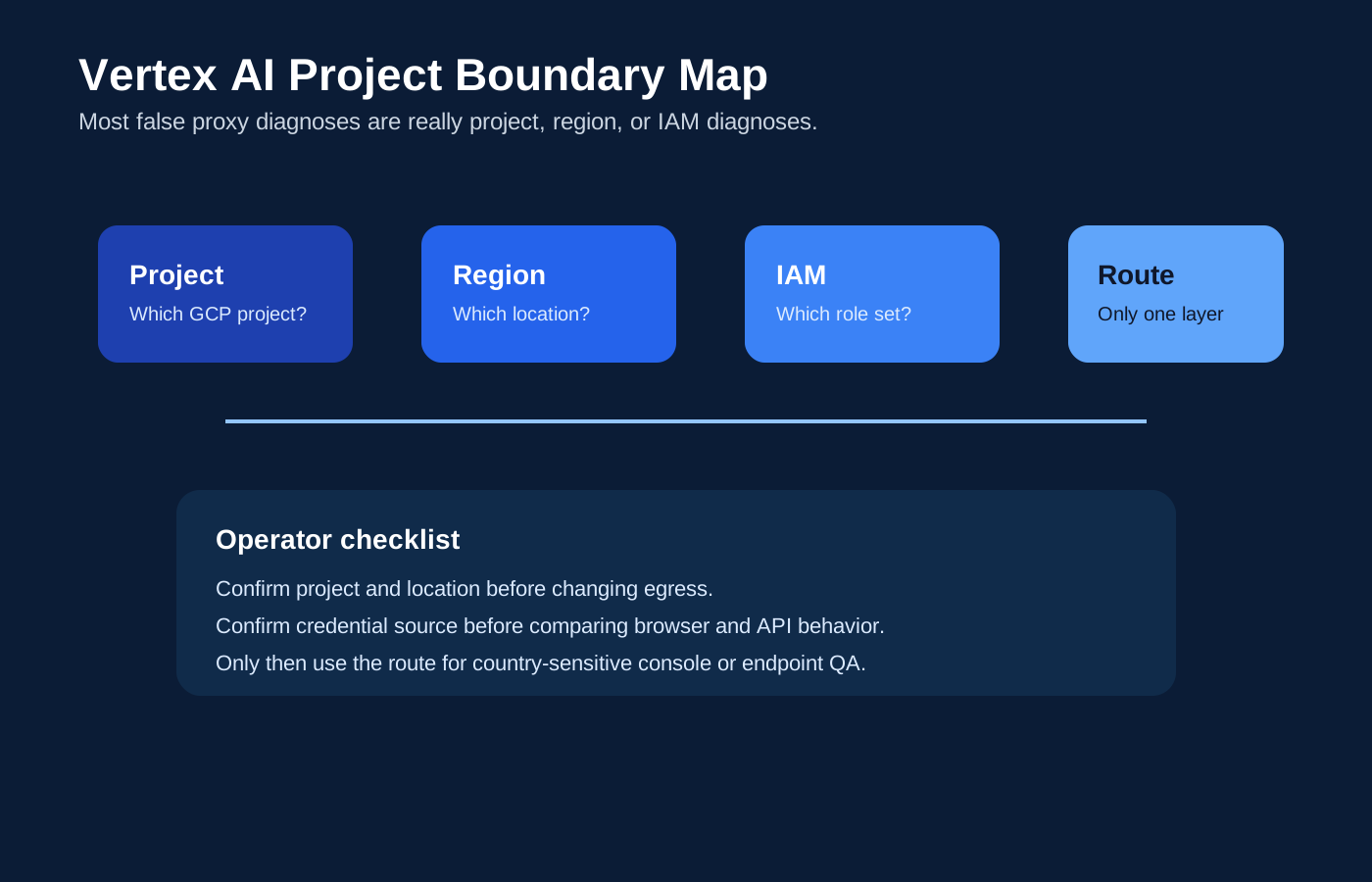
When Vertex AI fails, I check project, region, IAM, and credential source before I blame the network path.
Recommendation: I use proxies on Vertex AI only when they answer a narrow QA question: session stability, route separation, regional observation, or cleaner troubleshooting. I do not use them to imply entitlement, billing success, or policy bypass.
June 2026 AI access-layer evidence update
I now separate AI proxy recommendations into two layers: route control for accounts, CLIs, and gateways, and data-access tooling for browser agents or public-web retrieval. That keeps the recommendation from overselling raw IP rotation.
Bright Data is strongest when the workflow may need proxies plus Web Unlocker, SERP API, Browser API, Web Scraper API, or MCP access in one stack. The 2026-07-01 console capture showed the product surface as proxies, web access APIs, scrapers, datasets, and AI gateways rather than a proxy-only storefront.
Apify is the better comparison when the buyer wants a runnable Actor or MCP-connected automation flow. Its Store evidence captured on 2026-07-01 showed high-adoption actors such as compass/crawler-google-places near 486K users, apify/instagram-scraper around 314K users, and apify/google-search-scraper around 145K users.
For CLI and API gateway work, I would use Bright Data-style routing when session stability, country QA, or managed unblocking matters. I would use Apify when the task is really a scraper/automation job that should return structured output instead of only changing egress IP.
| Layer | What the evidence supports | Best fit |
|---|---|---|
| Raw proxy route | Sticky residential, ISP, or datacenter | Account QA, CLI auth stability, gateway admin checks, and regional observation. |
| Managed access layer | Web Unlocker, SERP API, Browser API, MCP, or Actor | Agent browsing, search retrieval, structured extraction, and data collection where raw proxies are not enough. |
Evidence note: Figures above come from logged-in or API-captured Bright Data and Apify evidence dated 2026-07-01. No API tokens, account IDs, billing records, or private screenshots are published here.
Current platform boundary I start from
Vertex AI depends on Google Cloud projects, IAM roles, locations, and either ADC, service-account JSON, or sometimes API-key-based express flows.
My working read on this surface
Vertex AI creates a classic false diagnosis pattern: operators see model access fail from one environment and call it a proxy or region problem, when the actual issue is usually project, IAM, location, org policy, or the credential source the runtime is really using.
What usually changes the result before the proxy does
The common mistake is assuming Vertex AI is just Google AI Studio plus enterprise billing. Operationally it is a different surface: project-scoped, IAM-scoped, and often tied to ADC or service-account behavior.
What breaks in practice first
- The model is called from the wrong project or region, but the operator keeps changing routes instead of confirming cloud context.
- An ADC path, service-account path, and browser-console path are all mixed into one test, so network conclusions become meaningless.
- The team assumes a service account can stand in for a human console login flow, then blames the route when the workflow model is wrong.
What I use the route to observe
- keep project, region, and identity tests separate during cloud QA
- verify dashboard, API key, and project behavior from the intended route
- avoid blending enterprise projects, consumer accounts, and cached credentials
What I will not promise from a proxy
- They cannot replace IAM roles, enabled APIs, or project-level permissions.
- They cannot fix a wrong region, wrong project, or organization policy restriction on their own.
- They cannot make consumer login shortcuts equivalent to service-account or enterprise auth.
My observation vs claim-to-avoid matrix
| Scenario | Proxy type I prefer | What I am actually observing | Claim I avoid |
|---|---|---|---|
| Vertex AI console session | Sticky residential or ISP | Whether the admin console behaves consistently once project and IAM are fixed | That the route can replace project or IAM work |
| API key or lightweight endpoint checks | Datacenter | Whether the endpoint itself is reachable and attributable | That reachability proves the cloud project is configured correctly |
| Project and region QA | Country-specific residential | Whether a region-specific console or product surface is being shown | That one region result explains every project failure |
| Consumer vs enterprise separation | One route per identity | Whether the operator is mixing AI Studio style access with enterprise project behavior | That overlapping model brands imply the same auth surface |
When I would use a proxy here
- You need region-aware QA around console access, project behavior, or cloud endpoints.
- You need to isolate one cloud project or admin session from another route or org context.
When I would not buy one yet
- You have not confirmed project ID, IAM, enabled APIs, and region before touching the route.
My practical QA workflow
- Write down project, location, enabled APIs, and the credential source the tool is supposed to use.
- Verify direct project access first before switching routes.
- Use one stable route when testing admin consoles or project dashboards so cloud context stays attributable.
- Only then compare region behavior, consumer account behavior, and enterprise project behavior separately.
Provider shortlist I would start with
| Provider | Best fit for this page | Why I would start here |
|---|---|---|
| Bright Data | Best when Vertex AI testing mixes project isolation, region checks, admin-console access, and occasional browser or data-layer escalation. | Best overall for production AI workflows, geo QA, and public-web access layers. |
| Proxy-Seller | Useful when Vertex AI work is mostly admin-console or project-session stability instead of broad regional rotation. | Strong self-serve option for dedicated or sticky session control at a lower cost. |
| IPRoyal | Useful for smaller Vertex AI checks when you mainly want route separation and not a full managed browser stack. | Good budget pick for smaller sticky residential or ISP-style session workflows. |
What I log before I change anything
- Project ID
- Location
- Credential source
- Console vs API path
Related AI proxy pages
- AI Proxies
- Best AI Proxy Providers for 2026
- Google AI Studio Proxies for 2026
- Vertex AI Proxies for 2026
- Vertex Credential Import for 2026
- Google Application Default Credentials Proxies for 2026
FAQ
Do I actually need a proxy for Vertex AI?
Only when you need network separation, country-specific QA, gateway routing, or a more stable browser or CLI session than your default path provides.
Which proxy type is the safest default for Vertex AI?
For account or CLI sessions, sticky ISP or static residential is usually the safest default. For broader country QA, rotating residential is more flexible.
What cannot be fixed by a proxy on Vertex AI?
Expired credentials, unsupported countries, missing entitlements, bad project settings, and broken gateway logic are all outside the proxy's control.
Sources checked
- https://cloud.google.com/vertex-ai/generative-ai/docs/start
- https://cloud.google.com/docs/authentication/application-default-credentials
- https://google-gemini.github.io/gemini-cli/docs/get-started/authentication.html
- https://brightdata.com/proxy-types
- https://ai.google.dev/gemini-api/docs/api-key
Final verdict
I use proxies on Vertex AI once the underlying surface is clear and the observation goal is narrow. The route can help me isolate state, compare markets, and keep QA repeatable, but it is not a substitute for real entitlements, clean auth, or correct project setup.