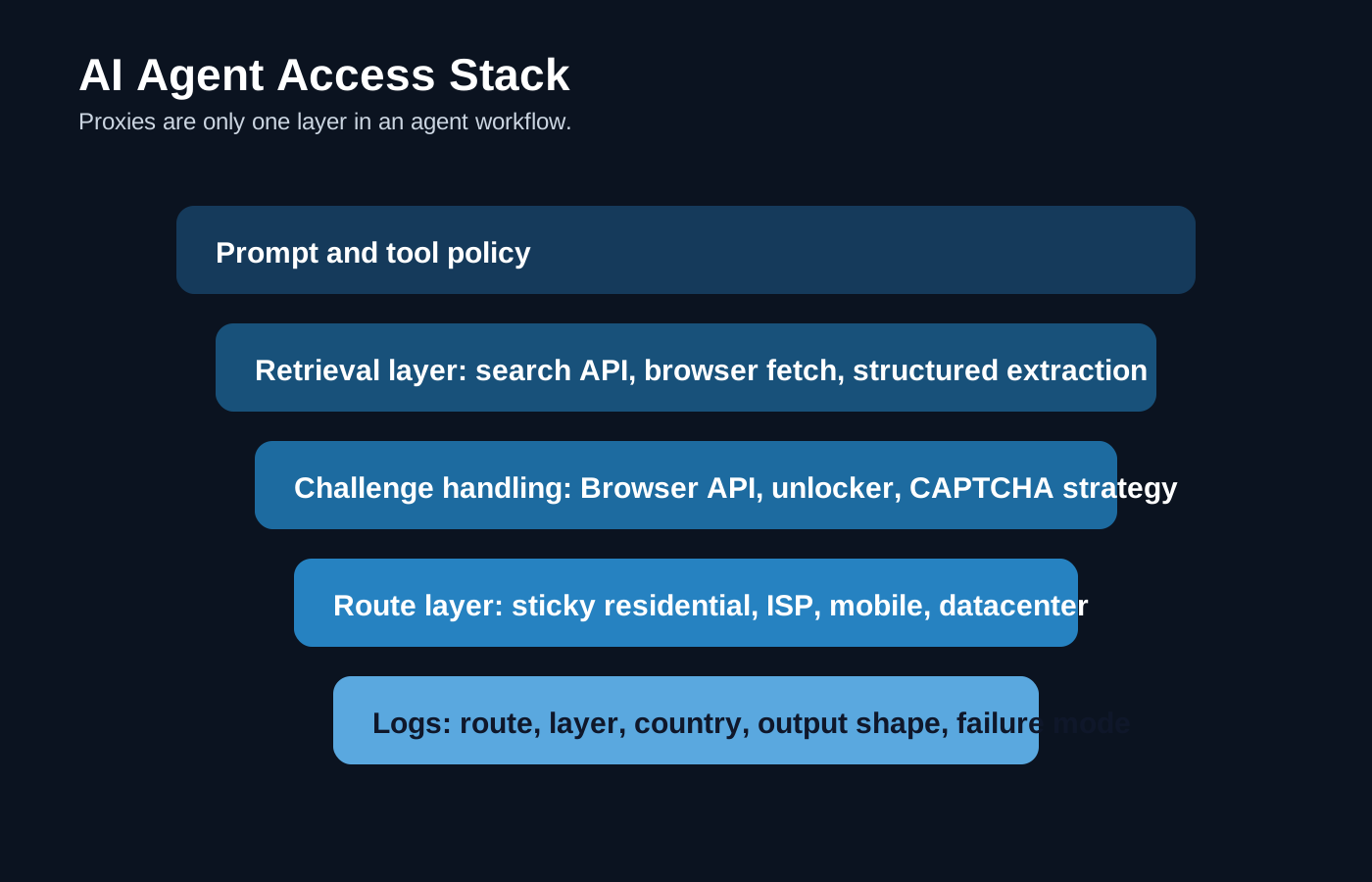
When I work on AI agents, I assume the first question is which access layer is missing: raw proxies, browser rendering, unlocker support, search retrieval, or structured extraction.
Recommendation: I use proxies on AI agents only when they answer a narrow QA question: session stability, route separation, regional observation, or cleaner troubleshooting. I do not use them to imply entitlement, billing success, or policy bypass.
Bright Data free tier scope note (June 2026): New PAYG accounts receive 5,000 free credits per month, with no credit card required. If those credits run out and there is no paid balance, usage stops instead of creating surprise charges.
The monthly credits apply to Unlocker API, SERP API, Web Scraper API, and Scraper Studio. Bright Data's docs also state that MCP server requests draw from the same pool because the MCP server runs on Unlocker API. Proxy products are not included, and Browser API is still outside the recurring monthly free-credit pool. See Bright Data's official free tier details for the current scope.
Current official baseline I start from
AI agents need more than generic IP rotation when they must browse, click, search, extract, and persist state across multiple sites.
My working read on this surface
The biggest information gap with AI agents is that teams still treat them like classic scraper fleets. Modern agents fail at several layers: browser runtime, challenge handling, search retrieval, extraction shape, and state continuity. Raw proxies are only part of that story.
What usually changes the result before the proxy does
The common mistake is assuming a larger proxy pool will make an agent reliable. In practice, rendering, browser automation quality, unlocker behavior, and retrieval orchestration often matter more.
What breaks in practice first
- The agent needs rendering and interaction, but the team keeps optimizing raw proxy rotation instead of moving up to a browser or unlocker layer.
- Public-web retrieval, search retrieval, and structured extraction are all mixed into one agent pipeline without logging which layer produced which result.
- The route is stable, but the agent still fails because CAPTCHA, challenge, or extraction-shape issues were misdiagnosed as IP quality problems.
What I use the route to observe
- choose the right access layer for browser actions, search retrieval, or scraping
- keep agent browsing sessions stable across multi-step tasks
- reduce public-web block rates without pretending that raw proxies solve every browser problem
What I will not promise from a proxy
- They cannot replace the need for browser automation when the target requires clicks or rendering.
- They cannot guarantee perfect public-web access if the agent flow itself is broken or abusive.
- They cannot turn a poor extraction schema into good data quality.
My observation vs claim-to-avoid matrix
| Scenario | Proxy type I prefer | What I am actually observing | Claim I avoid |
|---|---|---|---|
| AI agents raw fetch path | Residential proxies | Whether plain requests are enough for the target data | That a bigger pool replaces browser automation |
| Rendered browser steps | Managed browser or sticky residential plus browser control | Whether the workflow really needs clicks, JS rendering, or persistent browser state | That raw proxies and a browser extension are equivalent |
| Search retrieval | SERP API or managed retrieval layer | Whether the job is really search acquisition instead of page fetching | That one proxy vendor automatically covers every retrieval surface |
| Blocked public-web targets | Unlocker or browser-grade layer | Whether the workflow needs challenge handling, not just route diversity | That more IPs alone solve anti-bot pressure |
When I would use a proxy here
- You need repeatable route control for one agent browser, one search pipeline, or one public-web retrieval layer.
- You already know whether the workflow needs raw proxy egress, a managed browser, an unlocker, or a search API.
When I would not buy one yet
- You still cannot say whether the agent's failure is network, rendering, extraction, or challenge-handling related.
- You have not yet isolated the browser and retrieval stack from the proxy stack.
My practical QA workflow
- Decide whether the job is raw requests, browser rendering, search retrieval, unlocker-style access, or structured extraction.
- Test the simplest layer that can actually return the needed data shape.
- Keep one stable route and log each retrieval layer separately so browser, search, and proxy failures do not blur together.
- Only add more routing complexity if the current layer is proven insufficient for rendering, challenge handling, or extraction fidelity.
Provider shortlist I would start with
| Provider | Best fit for this page | Why I would start here |
|---|---|---|
| Bright Data Web Data Stack | Best when AI agents is really a browser or structured-extraction problem and the operator wants fewer moving parts than DIY proxies plus browser patches. | Best fit when the workflow needs Browser API, Web Unlocker, SERP API, or structured web data. |
| SOAX | Strong when AI agents is tied to structured extraction, crawling reliability, and data-pipeline discipline rather than pure consumer account QA. | Strong alternative for AI data extraction, public-web pipelines, and structured scraping workflows. |
| Decodo | Useful when AI agents work needs practical self-serve data access and browser-adjacent testing without a full custom pipeline. | Balanced self-serve alternative for data extraction, dashboard access, and lighter automation. |
What I log before I change anything
- Retrieval layer used
- Country and route type
- Whether rendering or challenge handling was involved
- Output format expected from the run
Related AI proxy pages
- AI Proxies
- Best AI Proxy Providers for 2026
- AI Agent Proxies for 2026
- Browser API Proxies for 2026
- Web Unlocker for AI Agents in 2026
- SERP API for AI Agents in 2026
- RAG Proxies for 2026
FAQ
Do I actually need a proxy for AI agents?
Only when you need network separation, country-specific QA, gateway routing, or a more stable browser or CLI session than your default path provides.
Which proxy type is the safest default for AI agents?
For account or CLI sessions, sticky ISP or static residential is usually the safest default. For broader country QA, rotating residential is more flexible.
What cannot be fixed by a proxy on AI agents?
Expired credentials, unsupported countries, missing entitlements, bad project settings, and broken gateway logic are all outside the proxy's control.
Sources checked
- https://brightdata.com/proxy-types
- https://brightdata.com/products/scraping-browser
- https://docs.brightdata.com/scraping-automation/scraping-browser
- https://docs.brightdata.com/scraping-automation/serp-api
- https://brightdata.com/products
Final verdict
AI agents only gets simpler once I admit that a proxy might not be the missing layer. If the workflow really needs rendering, search retrieval, or unlocker support, I would rather move up the stack than keep buying raw IPs.