I used to think ChatGPT Plus simply cost $20 everywhere. Then I watched people compare app-store screenshots, reseller invoices, gift-card balances, tax lines, and local-currency checkout pages. The subscription name was the same. The billing route was not.
Recommendation: Use regional proxies to observe pricing pages, localization, checkout display, app-store behavior, and access stability. Do not use a proxy to create a false billing identity, force a lower price, or bypass a provider's supported-country or payment rules.
The real information gap
Every few months someone asks the same question: how do I get ChatGPT Plus or Claude for the lowest monthly price?
I think that is the wrong first question. The better question is:
Which billing route matches my real account region, payment method, tax situation, and risk tolerance?
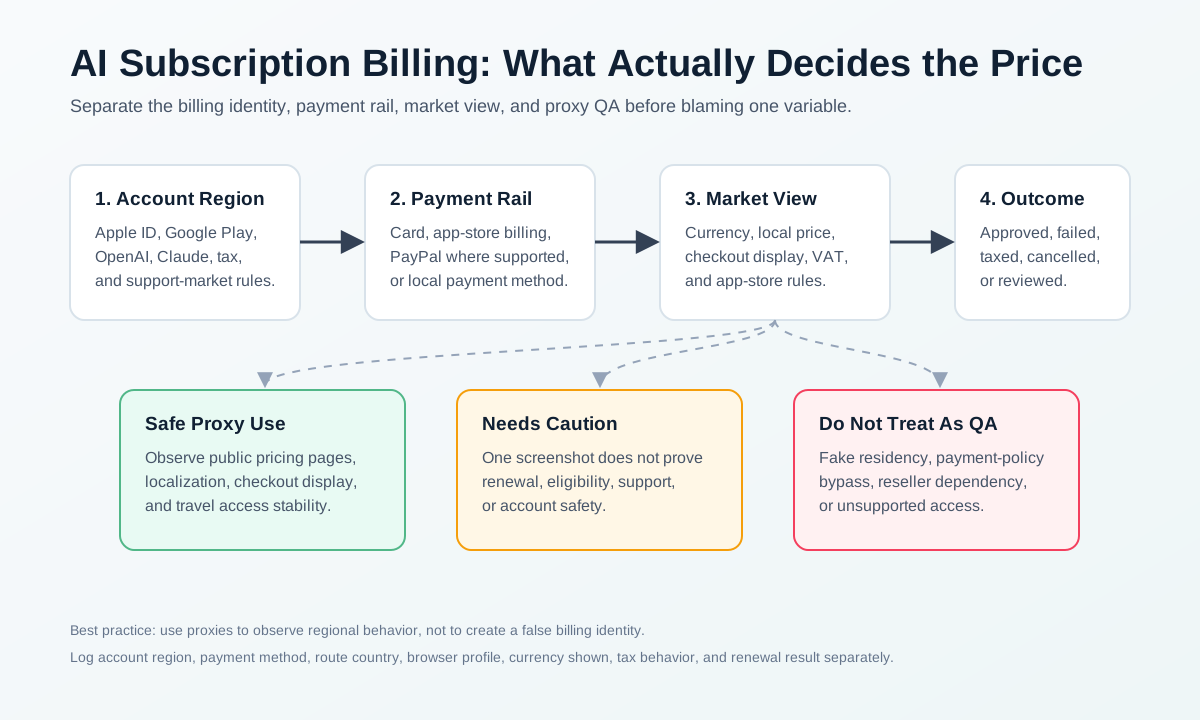
That distinction matters because AI subscriptions are no longer just a card charge on one website. The final bill can depend on the provider, the app store, the account country, the card issuer, PayPal availability, local taxes, VAT, foreign-exchange spread, gift-card markup, and whether the plan is being bought on web or mobile.
OpenAI's current public ChatGPT pricing page lists Plus at $20 per month on the web. OpenAI's Help Center also describes ChatGPT Plus as a $20/month plan. Anthropic's Help Center says Claude Pro is $20 per month in the United States, with local-currency pricing where supported, while Claude Max web tiers are listed at $100/month for Max 5x and $200/month for Max 20x. Those are clean reference prices, not a guarantee that every user sees the same final bill after taxes, currency conversion, platform billing, or local-region rules.
Why two users can pay different amounts
When I see two people paying different amounts for what looks like the same AI subscription, I usually check these variables before assuming anything unusual is happening:
- Provider price: the official web price from OpenAI, Anthropic, or another AI company.
- App-store price: the iOS or Android in-app subscription price, which can be affected by app-store country, platform rules, local taxes, and currency.
- Account region: Apple ID country, Google Play country, AI account country, and the country supported by the service.
- Payment method: credit card, debit card, PayPal where supported, mobile billing, app-store balance, gift card, or an alternative billing system.
- Tax treatment: U.S. sales tax, VAT-inclusive display, or tax added at checkout.
- Intermediary markup: reseller fees, gift-card spread, currency spread, and renewal risk.
- Route and session state: the visible country, browser profile, cookies, account history, and device reputation.
The mistake is collapsing all of that into one sentence: “The IP changed the price.” Sometimes the route changes what you can observe. It does not automatically change what you are eligible to buy.
My Apple billing checklist
For iPhone, iPad, and Mac users, Apple billing can be the cleanest route when the account region and payment method are legitimate. Apple documents that payment methods vary by country or region, and its region-change guidance says you may need a valid payment method for the new country or region.
Before I treat an Apple route as clean, I check:
- Does the Apple Account region match the user's actual billing situation?
- Is the payment method accepted in that Apple country or region?
- Does the billing address match the payment method and financial institution records?
- Are existing subscriptions or account balances blocking a country change?
- Is the subscription being managed by Apple or by the AI provider directly?
If those answers do not line up, a cheaper screenshot is not useful. It is just a fragile setup with poor support options.
My Google Play billing checklist
Google Play can also be straightforward when the Play country, payment method, and subscription path match. Google says available payment methods vary by country, and its payment-method page lists major cards such as Visa, Mastercard, American Express, Discover, and JCB where supported. It also notes that unsupported payment types and country-specific limitations can apply.
I check:
- Which Google Play country is active?
- Which payment methods are available for that country?
- Is the app using Google Play billing or an alternative billing system?
- If alternative billing is offered, who handles payment security, support, refunds, and subscription management?
- Does the AI subscription renew inside Google Play, inside the app, or on the provider's website?
This is where many people lose the thread. The first payment might work, but renewal, refund, support, and account recovery are the real tests.
Regional pricing is real, but eligibility is separate
Regional pricing is real. Claude's own Help Center says monthly pricing can vary by region and that some regions include taxes in the displayed price while others add tax at checkout. App stores also localize pricing, payment methods, taxes, and accepted funding sources.
But regional pricing does not mean every user should try to move into the cheapest visible market. Account country, payment method country, billing address, tax status, platform rules, and the provider's supported-country policy still matter.
OpenAI's supported-country page is especially direct: accessing or offering access to its services outside listed countries and territories may result in an account being blocked or suspended. I would rather publish that warning clearly than pretend a proxy is a magic subscription discount tool.
Where proxies actually help
I use proxies for observation, QA, and troubleshooting. That is different from using them to fake residency or bypass payment restrictions.
A good regional proxy setup can help me test:
- whether an AI pricing page loads in local currency
- whether VAT or sales tax appears in the checkout flow
- whether a public landing page changes copy, language, or product availability by country
- whether a mobile app, desktop app, or web session behaves differently by route
- whether a traveler or remote worker has a stable login route while abroad
- whether a support-market or localization claim is actually visible from the target country
That is valuable work for publishers, affiliate teams, SaaS operators, QA teams, support teams, and international users. It is not the same as promising payment success.
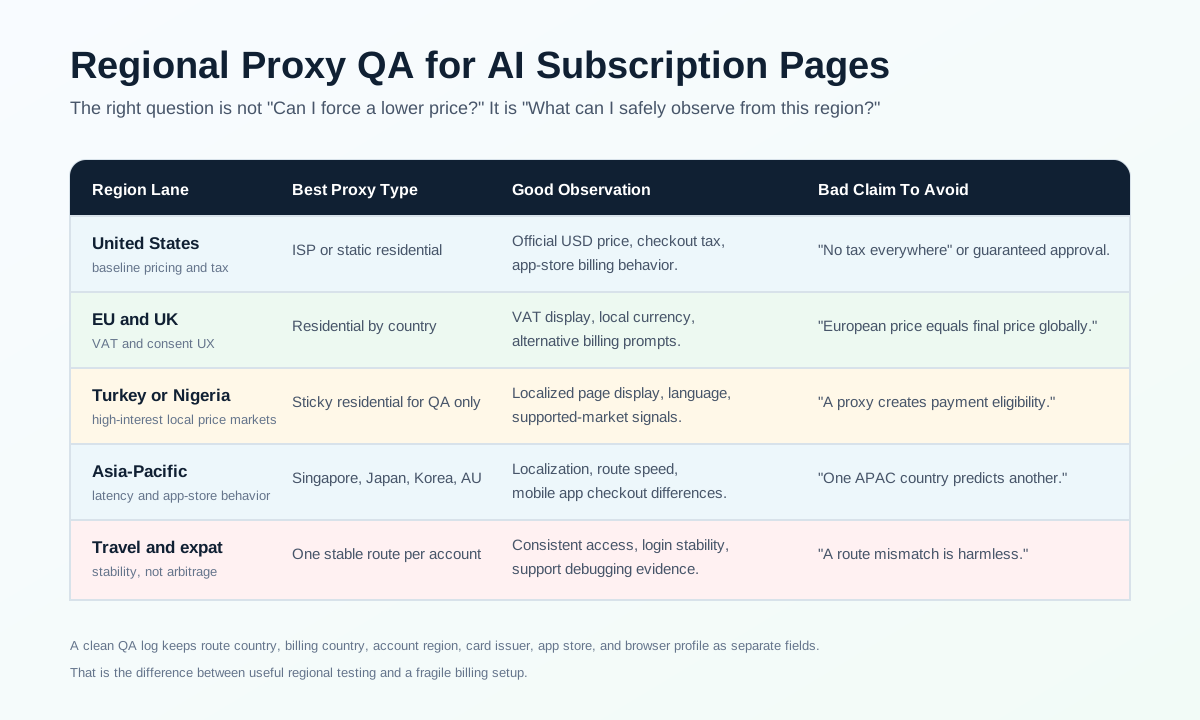
How I choose proxy type by region
| Scenario | Proxy type I prefer | What I am trying to learn | What I do not claim |
|---|---|---|---|
| U.S. baseline pricing | ISP or static residential | USD price display, sales-tax behavior, account login stability | That every state has the same final price |
| EU or UK pricing | Country-specific residential | VAT display, consent UX, local currency, app-store behavior | That one EU market predicts every other market |
| Turkey or Nigeria observation | Sticky residential for QA only | Localization, supported-market signals, checkout display | That a proxy creates payment eligibility or safe arbitrage |
| Asia-Pacific access | Singapore, Japan, Korea, Hong Kong, or Australia residential/ISP | Latency, language, app-store route, and regional product display | That all APAC countries behave the same |
| Travel or expat stability | One stable route per account | Consistent session behavior while moving networks | That account-region mismatch is harmless |
The provider stack I would shortlist
| Provider | Best fit for AI subscription QA | Why I would use it |
|---|---|---|
| Bright Data | Serious multi-country QA across pricing pages, app flows, browser sessions, and public-web checks | It gives me broad proxy-type coverage when I need to separate residential, ISP, mobile, and datacenter observations. |
| Proxy-Seller | Budget-conscious sticky routes and country-specific checks | It is a practical fit when the job is stable routing and controlled QA rather than a full enterprise data platform. |
| IPRoyal | Smaller AI billing or localization test loops | It can make sense when I need residential-style testing without buying a heavy stack first. |
| SOAX | Residential market checks and regional QA workflows | It belongs in the shortlist when the main job is comparing country behavior across controlled residential routes. |
Compare the best AI proxy providers
What I would not publish as advice
I would not tell readers to misrepresent residency, fabricate a billing address, rely on a random reseller, or treat gift cards as a guaranteed discount path. Gift cards can be legitimate in some app-store ecosystems, but they add region locks, exchange-rate spread, inventory risk, refund problems, and seller risk.
I also would not treat a local-currency screenshot as a reliable long-term cost estimate. The real bill depends on renewal, tax, card acceptance, platform rules, and whether the subscription can be supported when something breaks.
My practical QA workflow
- I start with the official web price from the provider.
- I check whether the subscription is being sold on web, iOS, Android, or through an alternative billing system.
- I record the account region, payment method country, billing address country, and tax behavior separately.
- I use a clean browser profile for each test so cookies and account history do not pollute the observation.
- I use one stable route per region instead of rotating IPs during checkout observation.
- I separate display observations from payment outcomes. Seeing a price is not the same as buying safely.
- I keep screenshots and notes for currency, tax, plan name, renewal interval, app-store path, and cancellation path.
Related AI proxy pages
- AI Proxies
- Best Proxies For AI
- ChatGPT Proxies
- Turkey ChatGPT Proxies
- Claude Proxies
- Agent Browser Proxies
FAQ
Can a proxy make ChatGPT Plus or Claude cheaper?
No. A proxy can help you observe regional pages, currencies, localization, and checkout display. It cannot create legitimate eligibility, guarantee payment approval, or override a provider's rules.
Why do people report different prices for the same AI subscription?
Because the billing route can be different. Web checkout, iOS billing, Android billing, local currency, VAT, sales tax, card spread, reseller markup, and annual billing can all change the visible or final cost.
Which proxy type is safest for subscription QA?
For logged-in account or checkout observation, I prefer sticky residential or ISP routes. For broad localization sweeps, rotating residential can work, but I do not rotate during payment-sensitive steps.
Should I use gift cards for AI subscriptions?
Only when they are a legitimate funding method for the account region you actually use. I do not treat gift cards as the default path because they add region-lock, refund, seller, and renewal risk.
Sources checked
- OpenAI Help Center: What is ChatGPT Plus?
- OpenAI: ChatGPT pricing
- OpenAI Help Center: ChatGPT supported countries
- Anthropic Help Center: Claude Pro cost
- Anthropic Help Center: Claude Max cost
- Apple Support: payment methods for Apple Account
- Apple Support: change Apple Account country or region
- Google Play Help: accepted payment methods
- Google Play Help: alternative billing systems
- Bright Data: proxy types
Final verdict
The cheapest-looking AI subscription route is not always the best route. I care more about a billing setup that renews reliably, matches the real account region, keeps support options intact, and gives me clean evidence when something changes.
Proxies still matter in that workflow. They help me see what real users in different markets see, test localization, compare app-store and web behavior, and keep travel or QA sessions stable. They just should not be sold as a shortcut around payment policy.