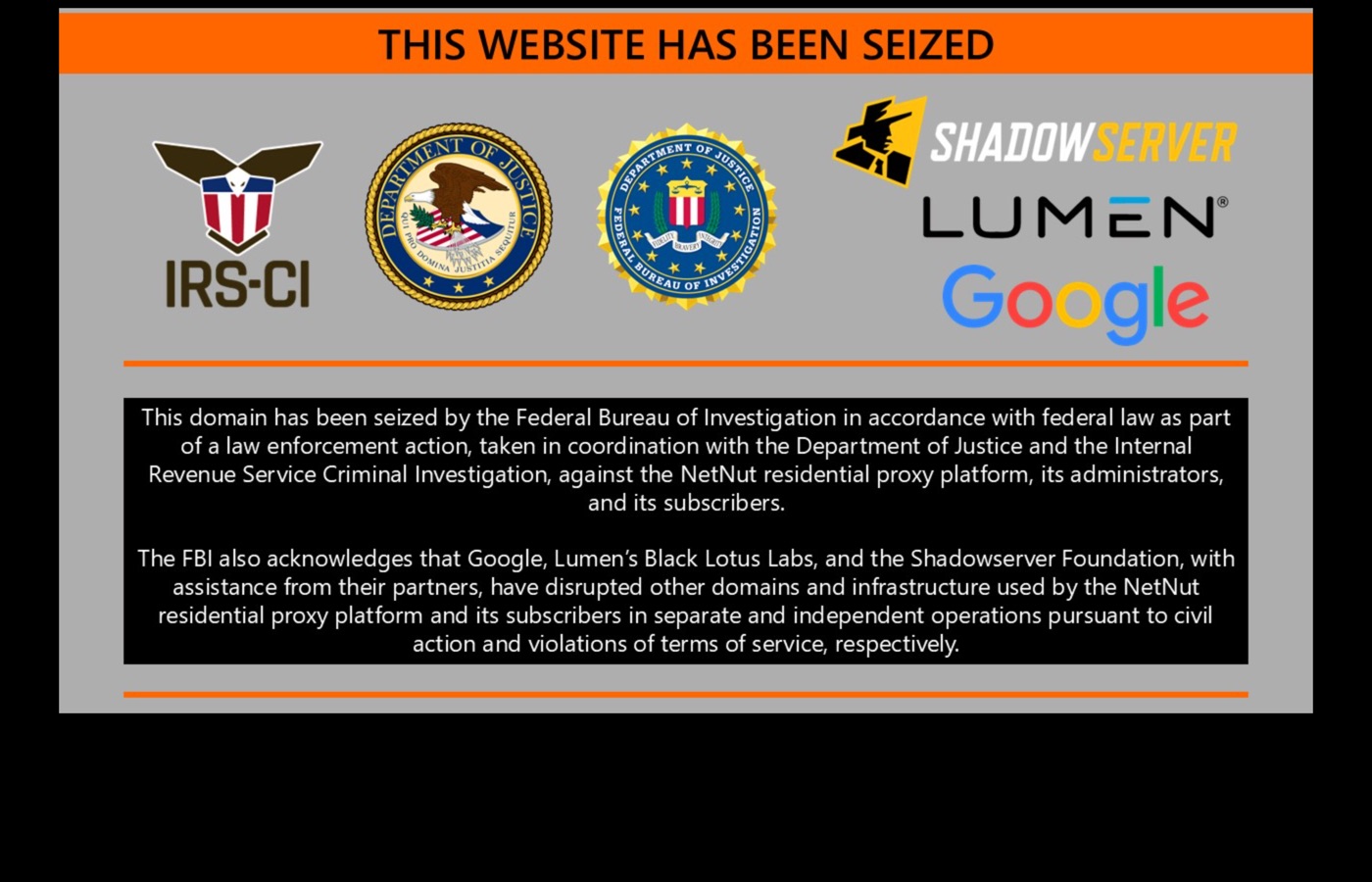
My inbox this week is full of one question: “We're on NetNut — what now?” Fair question. When your proxy provider's .com shows a federal seizure notice and its parent company tells investors parts of the network are paused, waiting to see how it plays out is not a strategy. Here's my honest answer.
Disclosure: BestProxyReviews is reader-supported. This page contains affiliate links and compensated placements, and we may earn a commission when you buy through them, at no extra cost to you. See our disclaimer for details.
What actually happened to NetNut
Quick recap, because the details matter more than the headlines. On July 2, 2026, Google's Threat Intelligence Group announced coordinated action with the FBI, Lumen, and others against the NetNut residential proxy network, also known as Popa. Domains got seized — netnut.com first, with proxyjet.io, divinetworks.com, and later netnut.io and alarum.io reported taken down as well. Google estimated the network at 2 million devices minimum and said the disruption cut the available pool by millions.
NetNut's parent company, Alarum Technologies (NASDAQ: ALAR), says it's cooperating with law enforcement and frames the event as third parties misusing its infrastructure. In its July 3 update, Alarum confirmed parts of its proxy network are paused and warned of a likely material adverse effect on its business if the disruptions persist.
I want to be precise here, because I've seen sloppier versions of this story all week: nobody official has said NetNut is finished. Google's own wording is “significant degradation” — not shutdown. If you want the full timeline with sources, I wrote it up in the NetNut disruption compliance breakdown, and our original NetNut review is still up for reference.
Do you actually have to switch?
Honest answer: maybe not permanently. But you need a working alternative now either way, and here's my reasoning.
- Continuity risk is live, not hypothetical. Parts of the network are paused by the operator's own admission. Domains are seized. Whatever the legal outcome, your pipeline doesn't care about legal outcomes — it cares about tonight's success rate.
- The white-label question cuts both ways. Google said it has high confidence that many popular residential proxy brands white-label the NetNut network — no brands named. So the honest version of “we don't use NetNut” is “we've verified our supply chain.” Most vendors can't say the second sentence. Ask yours. My supply-chain audit gives you the eight questions.
- Procurement won't wait. If compliance or legal reads the news, “we're monitoring the situation” buys you a week, maybe two. A documented evaluation of alternatives buys you actual time.
We've been here before, by the way. When Google disrupted the IPIDEA network in January 2026, I published the same kind of list — the IPIDEA alternatives guide — and the buyers who ran parallel trials that week had a much calmer month than the ones who didn't. Second disruption in six months. This is a recurring risk category now. Plan like it.
How I picked these alternatives
Four filters, in order of how hard I weight them after this event:
- Compliance evidence you can open. Trust centers, certifications, assurance reports, published sourcing policies — artifacts, not adjectives. The full framework is in my web scraping ethics checklist.
- Supply-chain transparency. Can the provider explain whether it runs its own peer network, and what its upstream looks like? After the white-label warning, this is non-negotiable.
- Performance in our testing history. These are all providers we've reviewed or tested on this site over the years, not names off a search page.
- Price sanity. Cheap is fine. Unexplainably cheap is a sourcing question wearing a discount.
The 10 best NetNut alternatives in 2026
1. Bright Data — the compliance-first heavyweight

No suspense: Bright Data tops this list, same as it topped the IPIDEA one, and the reason is boringly practical. When your procurement team asks “why this vendor?”, Bright Data is the only answer that comes with homework already done — a public Trust Center covering KYC, abuse prevention and monitoring, certification signals (ISO 27001:2022, ISO 27018, SOC 2, SOC 3), a PwC ISAE 3000 assurance page, and a published example of terminating SDK supply partners at its own cost. Add the deepest product stack in the market — rotating and static residential, ISP, mobile, datacenter, Web Unlocker, scraper APIs — and migration off NetNut is mostly a config change, not an architecture change. New accounts get a 60% discount on proxies and Browser API for 90 days with code BESTPROXY60, plus a first-deposit match up to $500. Full Bright Data review here.
2. Decodo — the ethical-first rebrand that grew up

Decodo (you may still know it as Smartproxy) has quietly become my default recommendation for teams that want strong residential performance without enterprise-tier pricing. The rebrand came with a visible push on ethical sourcing and cleaner developer tooling, and in our testing it's been one of the most consistent mid-market networks. Good balance of pool quality, dashboard usability, and support responsiveness. Our Decodo review has the details.
3. Proxy-Seller — the versatile all-rounder

Proxy-Seller covers more proxy types than almost anyone — residential, ISP, IPv4/IPv6 datacenter, mobile — with granular location targeting and a buy-exactly-what-you-need model that suits smaller, precise workloads. If your NetNut usage was static or ISP-flavored rather than huge rotating pools, this is the migration path I'd test first. Proxy-Seller review.
4. IPRoyal — cost-effective and growing fast
IPRoyal's pitch has stayed the same for years and it still works: honest pricing, non-expiring residential traffic, and a peer network (IPRoyal Pawns) where the value exchange to device owners is explicit — people knowingly sell their bandwidth. That's the consent model the whole industry is being pushed toward this month. For budget-conscious teams leaving NetNut, this is the strongest price-to-trust ratio on the list. IPRoyal review.
5. SOAX — the compliance model citizen
SOAX has built its brand on clean sourcing and strict KYC — it's one of the few providers where onboarding friction is the feature, not the bug. Flexible geo and ASN targeting, solid residential and mobile pools, and a team that answers sourcing questions without flinching. If your legal team is the one driving the NetNut exit, SOAX interviews well. SOAX review.
6. Proxy-Cheap — bulk collection on a budget
The name says it. Proxy-Cheap is where I point teams whose main constraint is cost per GB at volume — large residential pool, wide country coverage, pay-as-you-go friendly. You give up some of the compliance paperwork the top of this list offers, so run the sourcing questions before you scale on it. See Proxy-Cheap plans.
7. Webshare — the beginner-friendly option

Webshare's self-serve model is about as low-friction as this industry gets — free tier to test, transparent per-proxy pricing, instant setup. It's the right first stop for solo developers and small projects that used NetNut's lower tiers and don't need enterprise procurement theater. Try Webshare.
8. Geonix — precision geo-targeting

Geonix earns its slot for one job: workloads where city- or region-level targeting accuracy matters more than raw pool size — local SERP monitoring, regional price checks, geo-restricted verification. Narrower use case, but it does that job well. See Geonix.
9. HydraProxy — flexible payments, no commitments

HydraProxy suits the small-scale, pay-as-you-go crowd: no subscriptions forced on you, privacy-friendly payment options, and quick spin-up for short-lived projects. Not the pick for enterprise procurement, but a perfectly good escape hatch while you evaluate the bigger providers. Try HydraProxy.
10. Rayobyte — the ethics charter member
Rayobyte closes the list with a genuine differentiator: it's a founding member of the Ethical Web Data Collection Initiative (EWDCI) and has been loud about sourcing standards since before this month made it fashionable. US-based support and a broad product range across residential, ISP, and datacenter. See Rayobyte.
Quick comparison
| Provider | Best for | Standout compliance signal |
|---|---|---|
| Bright Data | Enterprise migration, full product stack | Trust Center + PwC assurance page + published supplier enforcement |
| Decodo | Mid-market residential workloads | Ethical-sourcing push post-rebrand |
| Proxy-Seller | Static/ISP and mixed proxy types | Granular, buy-what-you-need model |
| IPRoyal | Budget residential, non-expiring traffic | Explicit peer value exchange (Pawns) |
| SOAX | Compliance-driven teams | Strict KYC by design |
| Proxy-Cheap | High-volume budget collection | — |
| Webshare | Solo devs, quick starts | Transparent self-serve pricing |
| Geonix | Precision geo-targeting | — |
| HydraProxy | Short-term, no-commitment projects | — |
| Rayobyte | Ethics-conscious US buyers | EWDCI founding member |
How to switch off NetNut without breaking production
A migration checklist from someone who has watched several of these go badly:
- Run parallel, don't cut over. Stand up the new provider alongside NetNut and mirror a slice of real traffic. Compare success rates on your actual targets, not the vendor's demo targets.
- Map your session logic first. Sticky-session formats and rotation controls differ between providers. This is where most “the new proxy doesn't work” complaints actually come from.
- Check geo coverage against your real usage. Pull your last 30 days of NetNut geo distribution and verify the replacement covers it — not just “195+ countries” on a landing page.
- Ask the eight supply-chain questions before signing. You're switching because of a supply-chain event. Don't inherit the same blind spot with a new logo. The audit checklist is here.
- Keep the exit paperwork. Whatever you decide about your NetNut account, document the evaluation. That memo is what turns “we panicked and switched” into “we managed a supplier risk.”
What not to conclude
Don't read this list as “NetNut was guilty, everyone else is clean.” That's not what the record says — Alarum disputes the framing and is cooperating, and no reputable source has declared the company finished. And don't assume any alternative here is immune to supply-chain risk; the whole point of the last six months is that you verify, on paper, for every vendor. Screen whichever provider you pick with the proxy compliance checklist — including the ones I just recommended.
Final verdict
The NetNut disruption is the second reminder this year that a proxy network can lose millions of devices in a week. You can't control that. What you can control is how boring the event is for your own pipeline — and boring is the goal.
If you want the shortest path there: start a Bright Data trial today (code BESTPROXY60 gets you 60% off for 90 days), run it parallel to whatever you have, and make the keep-or-switch decision with your own numbers in hand. If budget is the constraint, IPRoyal and Decodo are the two I'd trial first instead.