Residential proxy buying changed in 2026, and I don't think it's changing back. The best procurement question is no longer “How many IPs do I get?” It's “Can this provider prove where the IPs come from, who gets access, what gets blocked, and how abuse is handled?”
Use this hub with the deeper residential proxy supply-chain audit if you need to verify whether the brand on your invoice actually operates the network behind it.
Disclosure: BestProxyReviews is reader-supported. This page contains affiliate links and compensated placements, and we may earn a commission when you buy through them, at no extra cost to you. See our disclaimer for details.

Why this checklist exists
Most proxy buying checklists — including plenty I've written over the years — start with IP pool size, country coverage, success rate, bandwidth price, and dashboard features. All useful. None of it answers the supplier-risk question, and in 2026 that's the question that bites.
Here's what forced the issue. In July 2026, Google Threat Intelligence Group published a report saying Google took coordinated action with the FBI, Lumen, and others against the NetNut residential proxy network, also known as Popa. Per Google, the action included disabling Google accounts and services used for malware command and control, sharing technical intelligence, and using Google Play Protect to warn users and disable apps known to include NetNut SDKs.
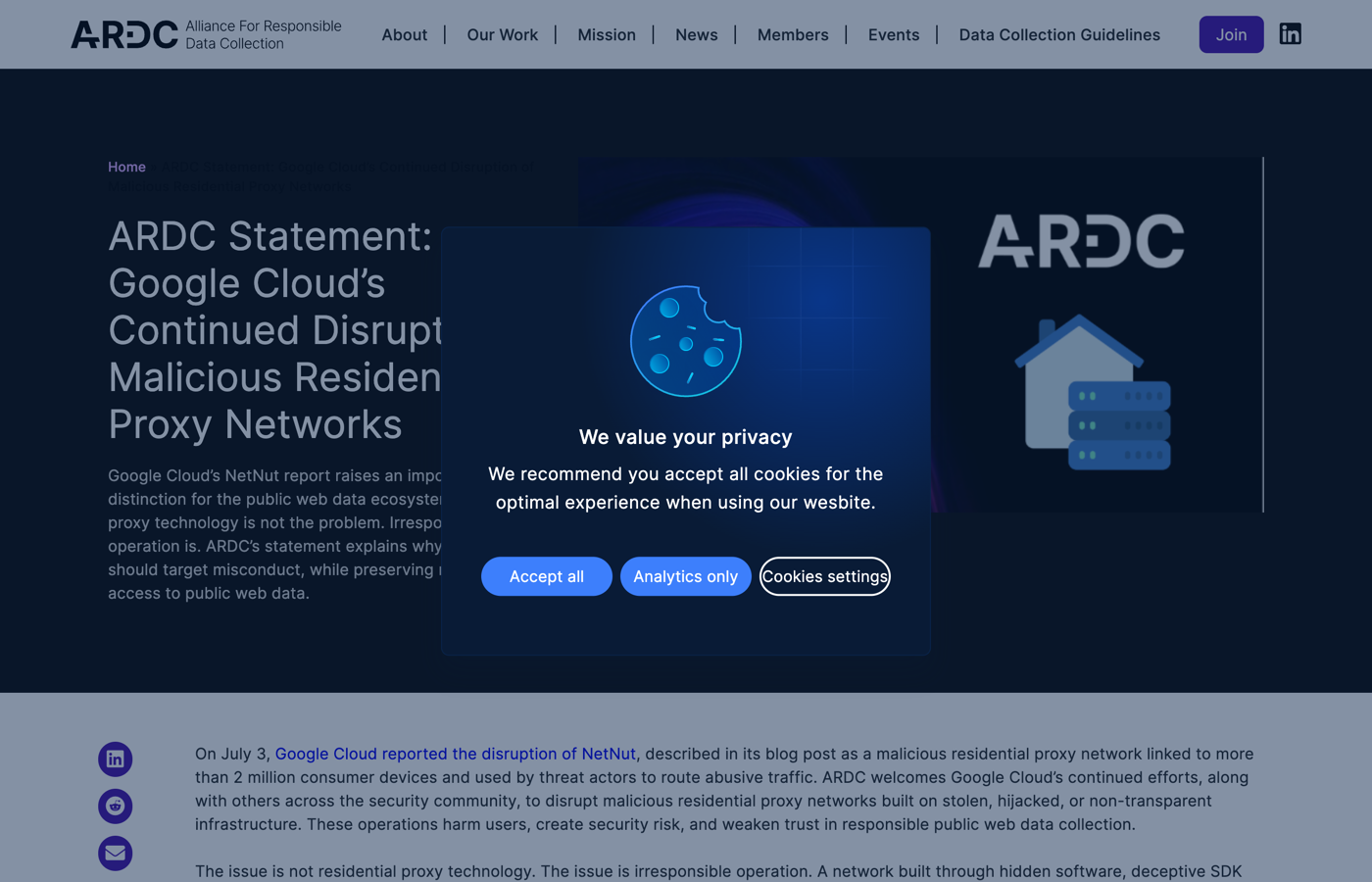
Does that prove all residential proxy technology is abusive? No — and ARDC's July 2026 response makes the more useful distinction: the problem is irresponsible operation, not residential proxy technology itself. For buyers, the takeaway isn't panic. It's better vendor review.
This page is the practical hub for that review. For the full ethics framework, read Web Scraping Ethics in 2026. For the event-specific analysis, read NetNut Disruption: Compliance Lessons for Residential Proxy Buyers. For upstream ownership and white-label risk, use the residential proxy supply-chain audit.
The 8-point proxy compliance checklist
| Question | Strong answer | Weak answer |
|---|---|---|
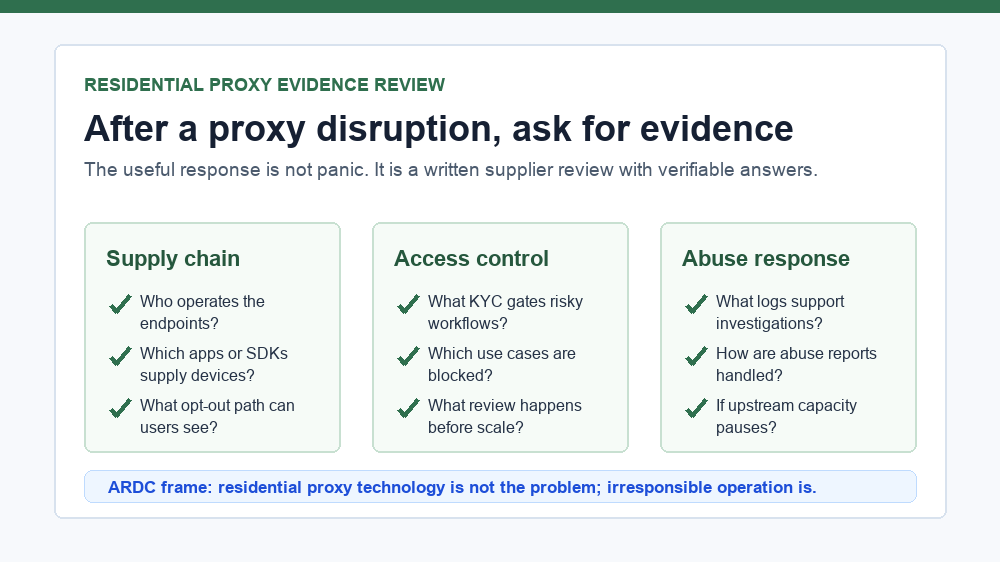
| How are residential IPs sourced? | Clear sourcing model, documented partner channels, informed consent, user value exchange, and opt-out. | Vague language such as “ethical network” with no explanation of user enrollment. |
| What customer KYC is required? | Risky access patterns require review before broad residential access is allowed. | No meaningful distinction between anonymous users and reviewed customers. |
| Which use cases are blocked? | Acceptable-use policy is connected to real blocking, review, throttling, or termination. | A generic policy page with no evidence that anything is enforced. |
| How is abuse handled? | Public abuse-reporting path, investigation process, and response controls. | No clear reporting path or only a support inbox with no abuse process. |
| Can device users opt out? | Clear user control, simple opt-out, and documented removal from the network. | Unclear SDK participation, unclear terms, or hidden device enrollment. |
| What monitoring exists? | Usage monitoring, filtering, suspicious-pattern review, and misuse escalation. | Provider says it trusts customers and reacts only after major complaints. |
| Which certifications are current? | Security, privacy, and compliance certifications are public or reviewable in procurement. | Only broad claims like “GDPR compliant” with little supporting evidence. |
| Is there independent assurance? | Audits, assurance reports, or third-party review artifacts are available for buyer review. | No external evidence beyond marketing copy. |
Use AIMultiple's three-part frame
AIMultiple's 2026 web scraping ethics benchmark earned a permanent spot in my bookmarks for one reason: it splits the problem into three buckets a procurement team can actually work with — ethical use by customers, ethical supply, and external certification.
Why does the split matter? Because vendors fail unevenly. I've seen providers with a genuinely strong residential pool that couldn't explain customer gating. Providers with a beautifully written acceptable-use policy and no answer on IP sourcing. Providers claiming privacy alignment with nothing for procurement to open and read. One strong bucket hides two weak ones unless you score them separately.
The caveat, straight from AIMultiple itself: a benchmark isn't a legal guarantee. Treat it as due-diligence input, then run your own review against your specific workflow, target sites, data categories, customer terms, and internal policy.
What changed after the NetNut disruption
The Google report took a risk that used to live in the background and made it operational. If a proxy network depends on hidden software, unclear SDK enrollment, or opaque upstream supply, capacity can disappear fast when platforms, researchers, or law enforcement partners move against the infrastructure. Not theoretically. Within days.
For a buyer, that lands as three exposures:
- Reputational risk: your vendor can become associated with hidden device enrollment or botnet-style infrastructure.
- Operational risk: capacity can degrade if an upstream network or reseller supply chain is disrupted.
- Compliance risk: your team may be unable to explain where traffic came from and what controls were applied.
The right response isn't panic — it's supply-chain review. Ask whether the provider owns its network, works through partners, resells capacity, or leans on white-label upstream sources. A vendor that can't give you a clear answer isn't ready for a serious procurement process, full stop.
Why Bright Data is the first provider to review
Bright Data isn't the only proxy provider worth evaluating, and I review plenty of others on this site. But if your buying process involves compliance, security, legal, or procurement sign-off, it's the first name I'd put on the shortlist — for a boring, practical reason: there's evidence to review.
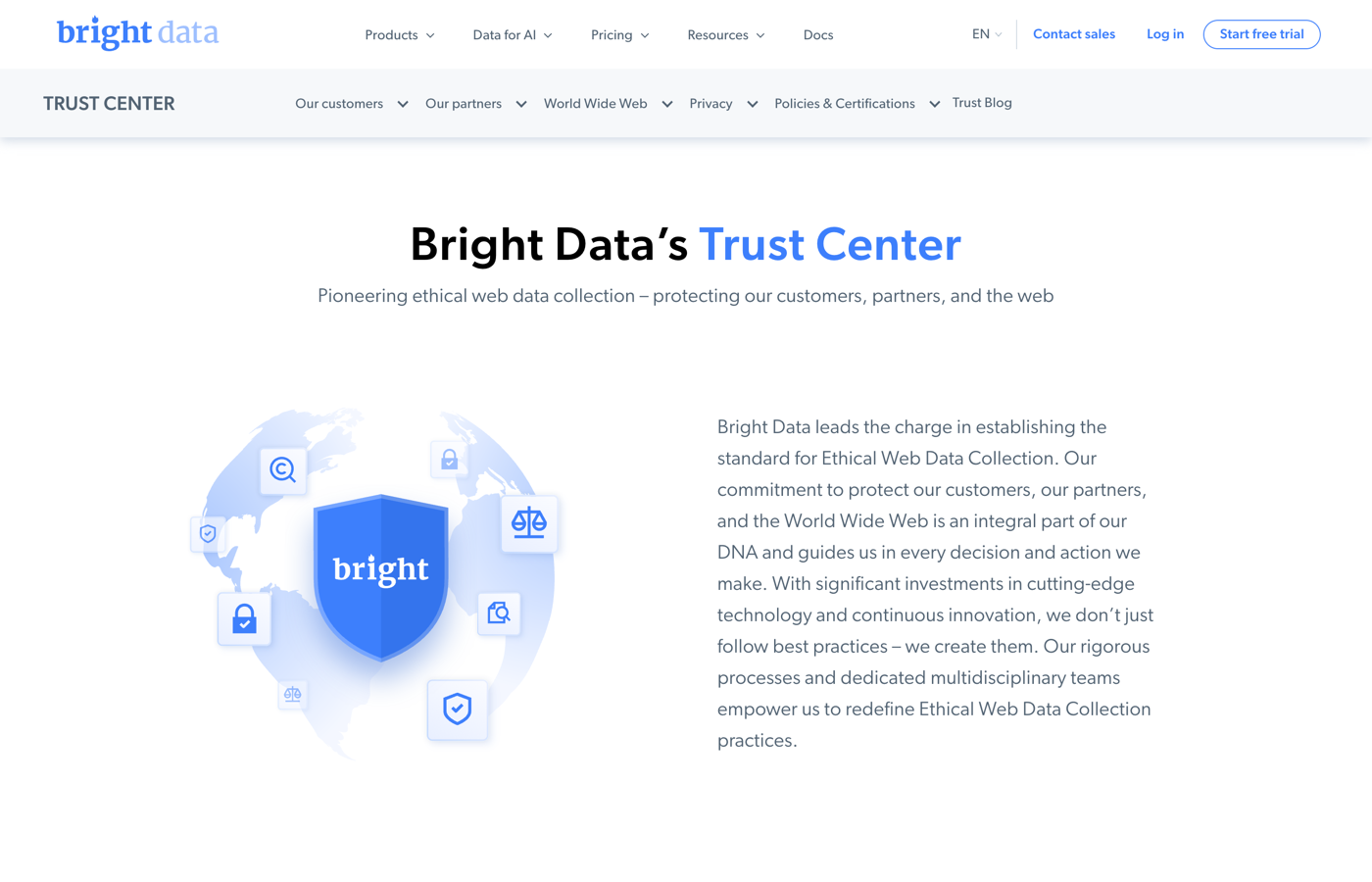
Bright Data's Trust Center points buyers to KYC, preventing abuse, web monitoring, usage monitoring and filtering, public web data, privacy, policies, and certification materials. It also lists signals such as GDPR, ISO 27001:2022, ISO 27017, ISO 27018, SOC 2, and SOC 3.
There's also a PwC assurance report page, which says Bright Data engaged PwC for an ISAE 3000 assurance engagement focused on internal compliance and ethics controls, with a report dated June 29, 2025.
None of that transfers your homework to Bright Data — PwC's own disclosure language says the report doesn't replace buyer-side inquiries and procedures. But it gives procurement something concrete to open, read, and cite in the approval memo. That's the point of this whole page.
Read our Bright Data review if you want the broader buyer view before starting a trial.
How to use this checklist internally
For a small project, run it as a quick vendor screen — an afternoon, maybe. For a production workflow, bake it into intake before traffic scales, split by team:
- Procurement: ask for trust-center links, certifications, assurance reports, sourcing disclosures, and abuse-policy evidence.
- Security: review how customer access is gated, monitored, filtered, and revoked.
- Legal or compliance: review target-site sensitivity, data minimization, retention, and customer obligations.
- Engineering: document whether the workflow needs proxies, Web Unlocker, scraper APIs, browser automation, prebuilt datasets, or managed collection.
If your workflow is AI data collection rather than classic scraping, read the updated legal and ethical AI data collection guide. If it's scraper operations, the updated web scraping practices guide is the better companion.
Red flags that should slow the deal down
- The provider can't explain how residential IPs enter the network.
- The provider can't describe user consent, value exchange, and opt-out.
- The provider treats KYC as optional even for sensitive residential workflows.
- The provider has no clear abuse-reporting path.
- The provider can't show current certification or assurance materials.
- The provider can't explain whether it uses upstream, reseller, or white-label supply.
- The provider gives only broad legal claims instead of reviewable artifacts.
To be fair: none of these automatically proves bad behavior. What they prove is that you're being asked to trust claims that should be documents. That's a different kind of problem, and in procurement it's usually the more expensive one.
Final verdict
A serious residential proxy provider should be able to explain its supply chain, access controls, abuse process, monitoring, certifications, and assurance evidence. When one can't, price and pool size are distractions — attractive distractions, but distractions.
My Compliance Week recommendation is genuinely simple: start with the provider that hands you the most reviewable evidence, then test performance. That's why Bright Data is the first provider I'd evaluate for a compliance-first residential proxy workflow in 2026.