Bright Data is the stronger buy when the job is “give me compliant, scalable access to data with less infrastructure babysitting.” Apify is the stronger buy when the job is “give me a runnable tool or actor for this source right now.”
Choose Apify if you care more about store-driven actor discovery, low-friction testing, and mixing community-built workflows source by source.
This page is based on more than public marketing copy. On July 1, 2026, I checked a funded Bright Data account and a logged-in Apify console account, plus the live Store and Bright Data docs. That matters because these two products look similar only if you stay at the slogan level.
The sharpest difference
The cleanest way to frame this comparison is simple: Bright Data sells managed access to data and web infrastructure, while Apify sells a marketplace of runnable scraping tools.
| Question | Bright Data | Apify | Winner |
|---|---|---|---|
| What am I really buying? | A provider-first stack: proxies, unblocking, pre-built scrapers, Scraper Studio, datasets, and managed service. | An actor marketplace and automation platform where you choose or build the workflow source by source. | Depends on the job |
| Best for supported mainstream targets | Very strong because the funded account catalog captured 537 supported domains and multiple applications per domain. | Strong if you prefer to search the Store for actors and compare developers manually. | Bright Data |
| Best for fast niche exploration | Good, but more provider-led and less catalog-like. | Very strong because the Store still encourages actor discovery by category, search, and creator. | Apify |
| Best for lower maintenance burden | Stronger because Bright Data owns more of the proxy, browser, and unblocker stack underneath the workflow. | Varies by actor and by how much tool selection and upkeep the buyer wants to own. | Bright Data |
| Best free entry point | Helpful trials and product-specific free usage, but not the strongest always-on free doorway. | Stronger because the account still showed roughly $5 in free platform credit and low-friction Store access. | Apify |
What I can verify from real accounts
The strongest comparison pages are not built from adjectives. They are built from real-account observations.
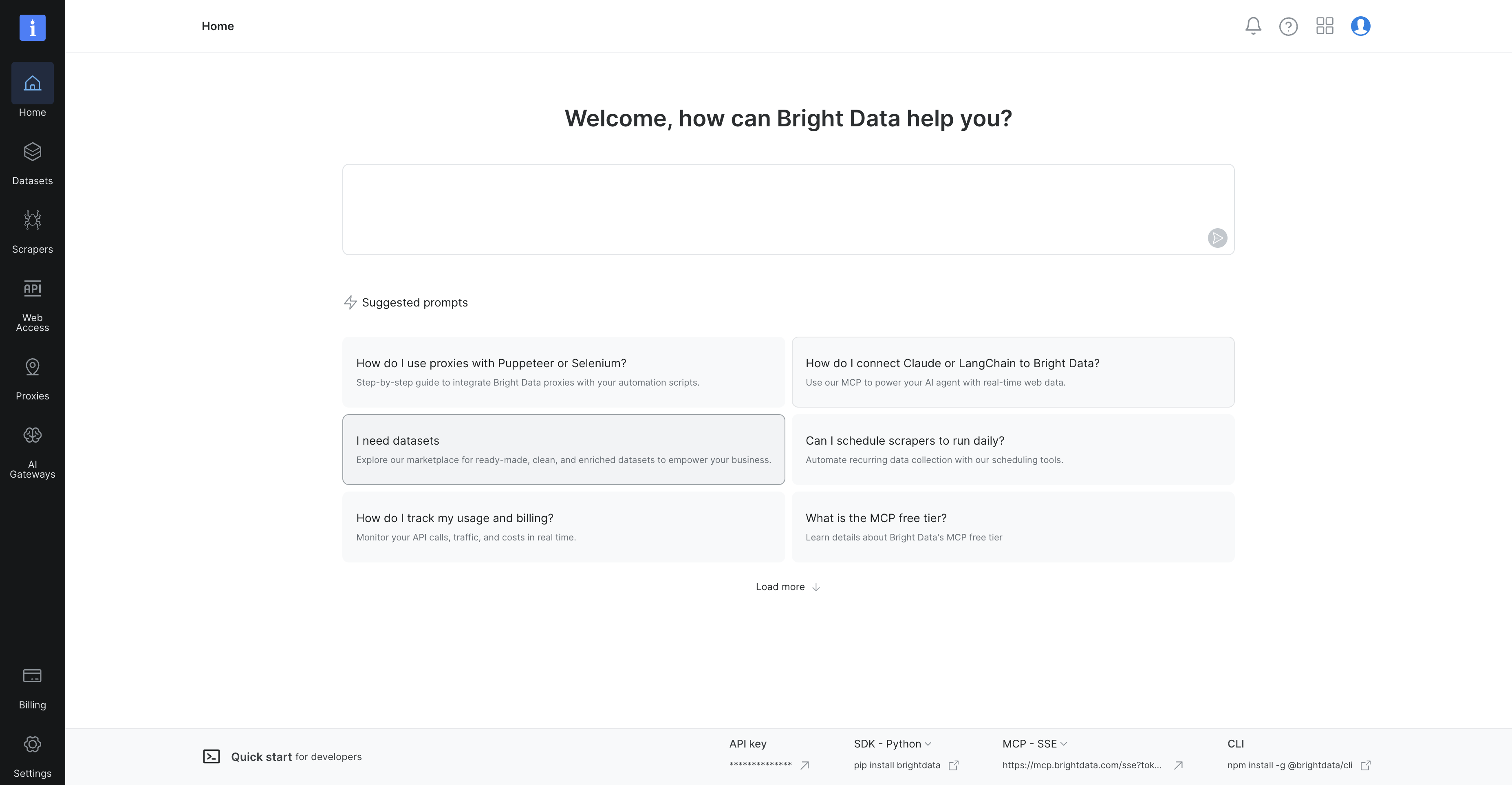
- Bright Data funded account: the logged-in environment showed Scrapers, Web Access, Proxies, AI Gateways, Billing, and Settings in the main product taxonomy, plus a real custom-scraper workflow in the account.
- Bright Data coverage proof: the authenticated catalog capture behind this article includes 537 supported domains, with category-heavy coverage in e-commerce and social targets.
- Bright Data adoption proof: the funded catalog shows LinkedIn around 170.8K users and Amazon around 46.1K users in the ready-scraper layer.
- Bright Data price proof: a real Amazon products endpoint in the authenticated account was captured at $1.50 / 1,000 records, not just a generic marketing headline.
- Apify funded console: the logged-in console account still showed the Store, Actors, Runs, Billing, and the familiar actor-centric workflow.
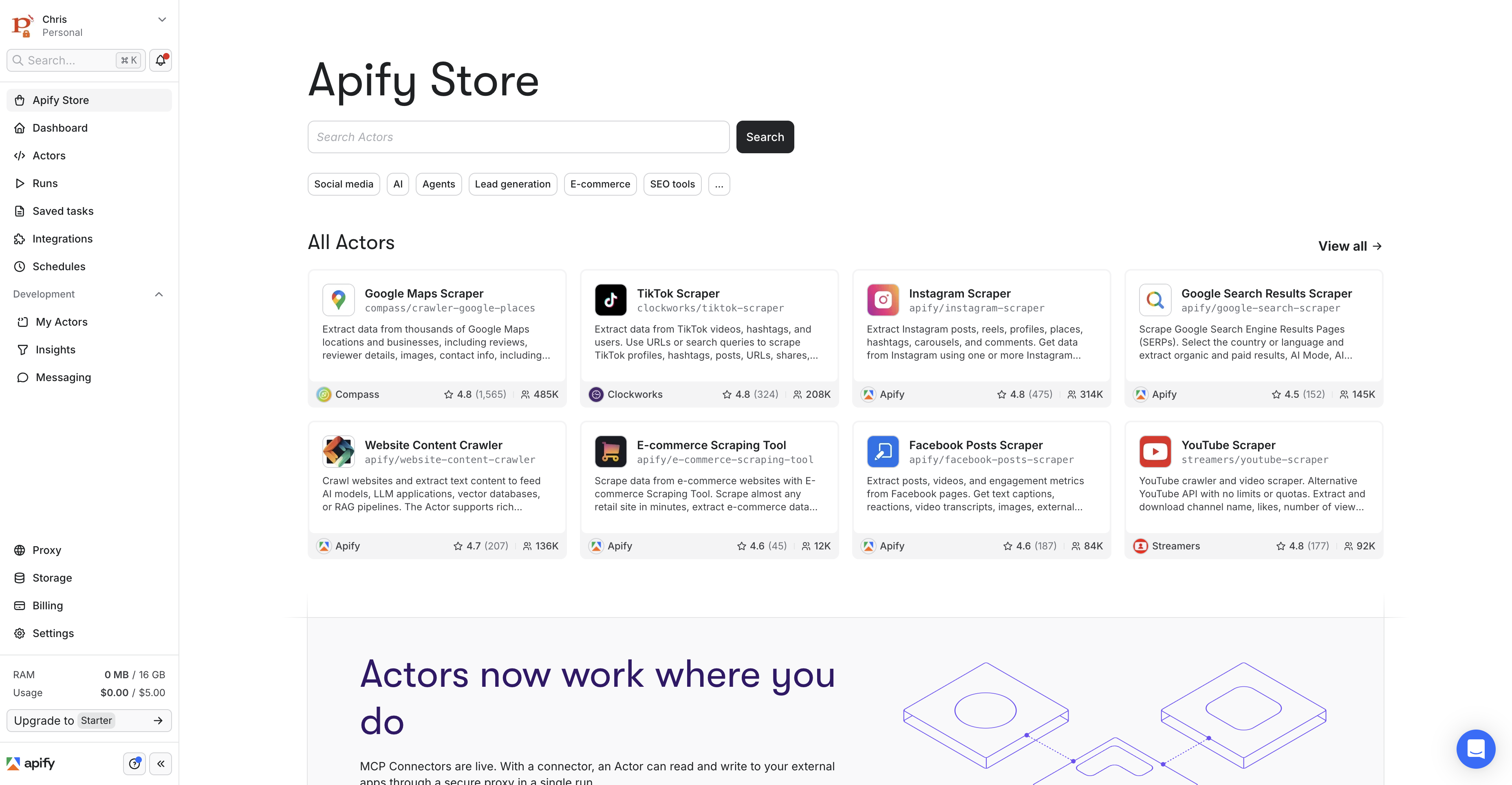
- Apify actor proof: the Store still showed Google Maps around 486K users, Instagram around 314K, TikTok around 208K, and Google Search around 145K among top actors.
Pricing that actually helps a buyer decide
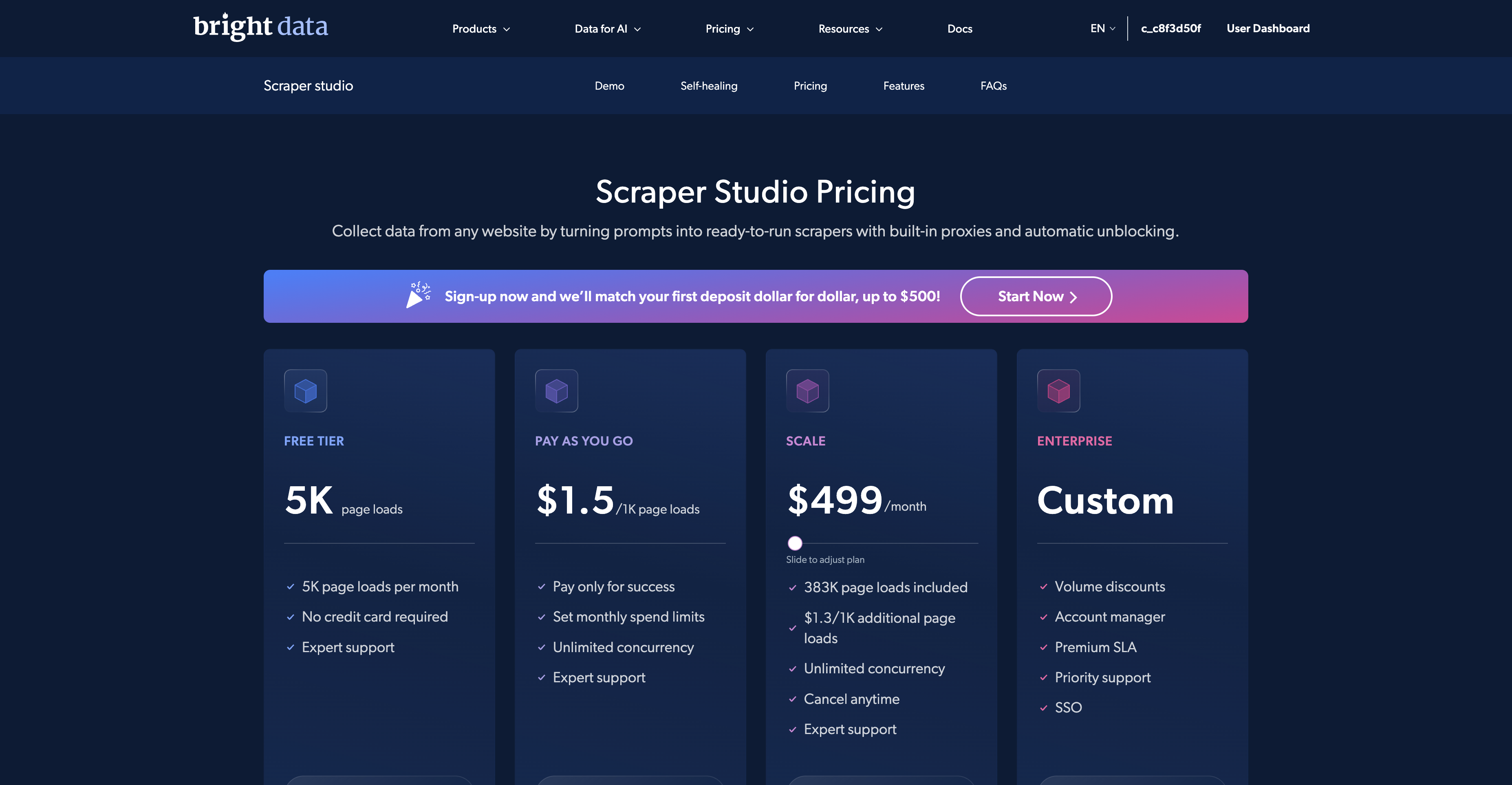
Comparison note: Bright Data's free tier is useful when comparing Apify with Bright Data's web-data APIs or Scraper Studio: new accounts get 5,000 monthly credits for that web-data pool, while proxies and Browser API stay separate.
Most comparison pages fail here because they compare one platform plan against a completely different billing shape. That is not useful. The more honest way is to compare the units a buyer is likely to feel first.
| Use case | Bright Data signal | Apify signal |
|---|---|---|
| Mainstream e-commerce data at predictable cost | Amazon products in the funded Bright Data account were captured at $1.50 / 1K records. | One Amazon actor in the Apify catalog was priced around $0.005 / result. |
| Search results | Bright Data pushes purpose-built search and scraper layers. | Apify's Google Search actor was priced around $0.0045 / search-result page. |
| Instagram-style result collection | Bright Data can route you through supported scrapers or custom workflows depending on the target. | Apify's Instagram actor was priced around $0.0027 / result. |
| Google Maps / local business collection | Bright Data has strong supported coverage and surrounding data-access stack. | Apify's flagship Google Maps actor was priced around $0.004 / scraped place. |
| Trying the platform without a budget discussion first | Useful trials and free product-specific usage, but not my favorite permanent low-friction test bed. | Apify still has the easier low-friction free-start story with roughly $5 in platform credit. |
The practical takeaway is that Bright Data is easier to justify when the buyer wants predictable access and lower infrastructure ownership. Apify is easier to justify when the buyer wants to try actors fast and compare multiple approaches without first deciding on one provider-shaped workflow.
How I would compare the first dollar spent
If I were advising a buyer with a limited first test budget, I would compare the first dollar differently on each platform. With Apify, the first dollar is often about exploration: what actor already exists, how much does one result or event cost, and how good is that actor's current maintenance? With Bright Data, the first dollar is more often about operational fit: does the supported scraper layer already solve the target, or does the target justify moving into Scraper Studio on Bright Data's managed stack?
That distinction matters because the first spend is not trying to buy the same outcome. Apify optimizes discovery first. Bright Data optimizes provider-shaped execution first.
Coverage and catalog reality
Bright Data and Apify both have “lots of stuff,” but they do not organize that abundance in the same way.
- Bright Data: the authenticated support matrix behind this article captured 537 supported domains, with multiple named applications per platform. Amazon alone had 13 application variants in the real account capture.
- Apify: the strength is not one canonical platform matrix. The strength is the actor marketplace itself: categories, creator discovery, store search, and a long tail of source-specific actors.
That difference changes how you shop. Bright Data asks, “Which managed data product layer fits this target?” Apify asks, “Which actor or actor family already exists for this target?”
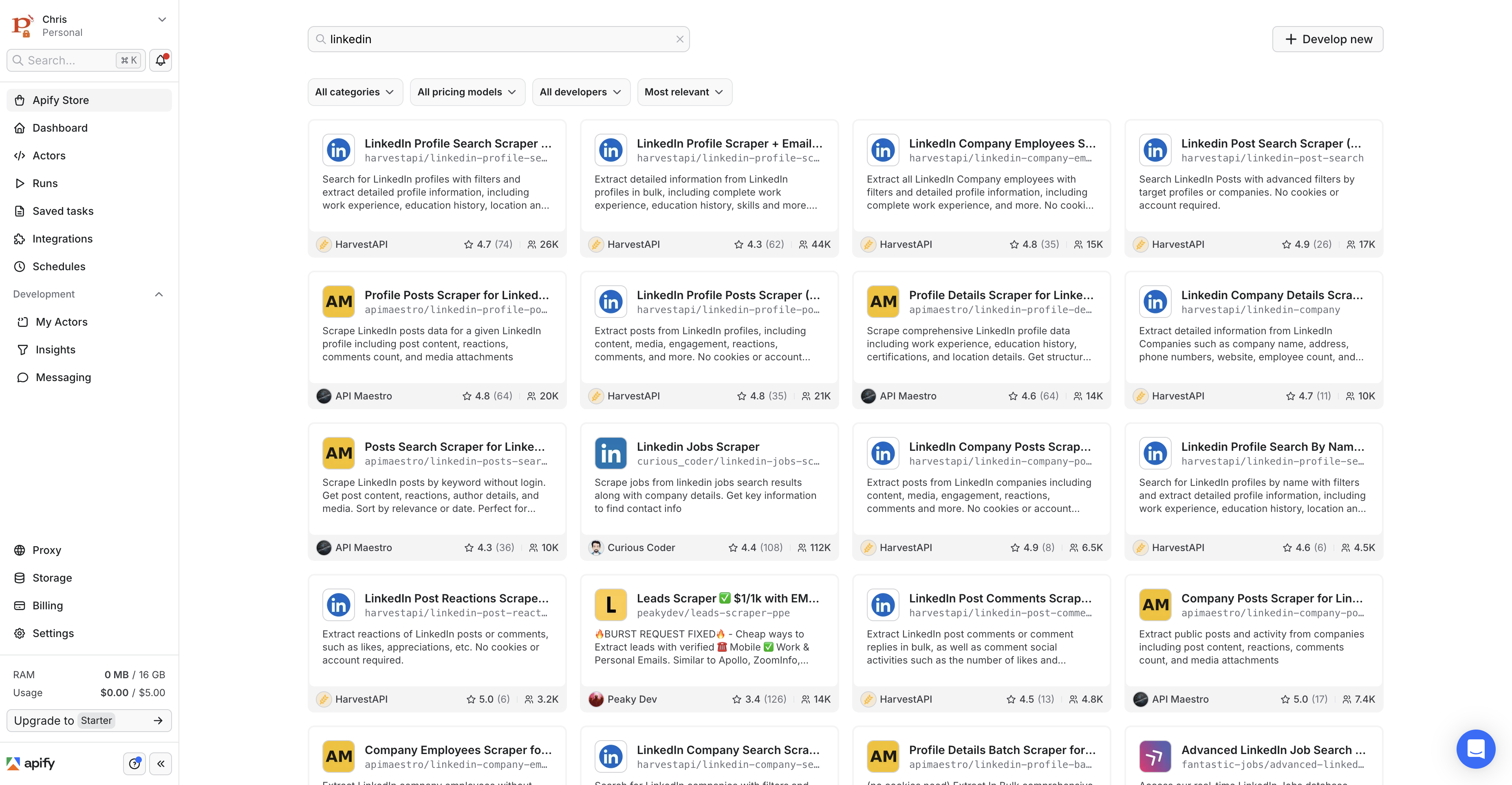
The LinkedIn Store search is a good example. On Apify, one query immediately opens a catalog of multiple actor paths from different developers. That is excellent for exploration. Bright Data's equivalent advantage is not actor variety; it is the fact that supported targets live inside one more unified provider stack.
What the workflow feels like
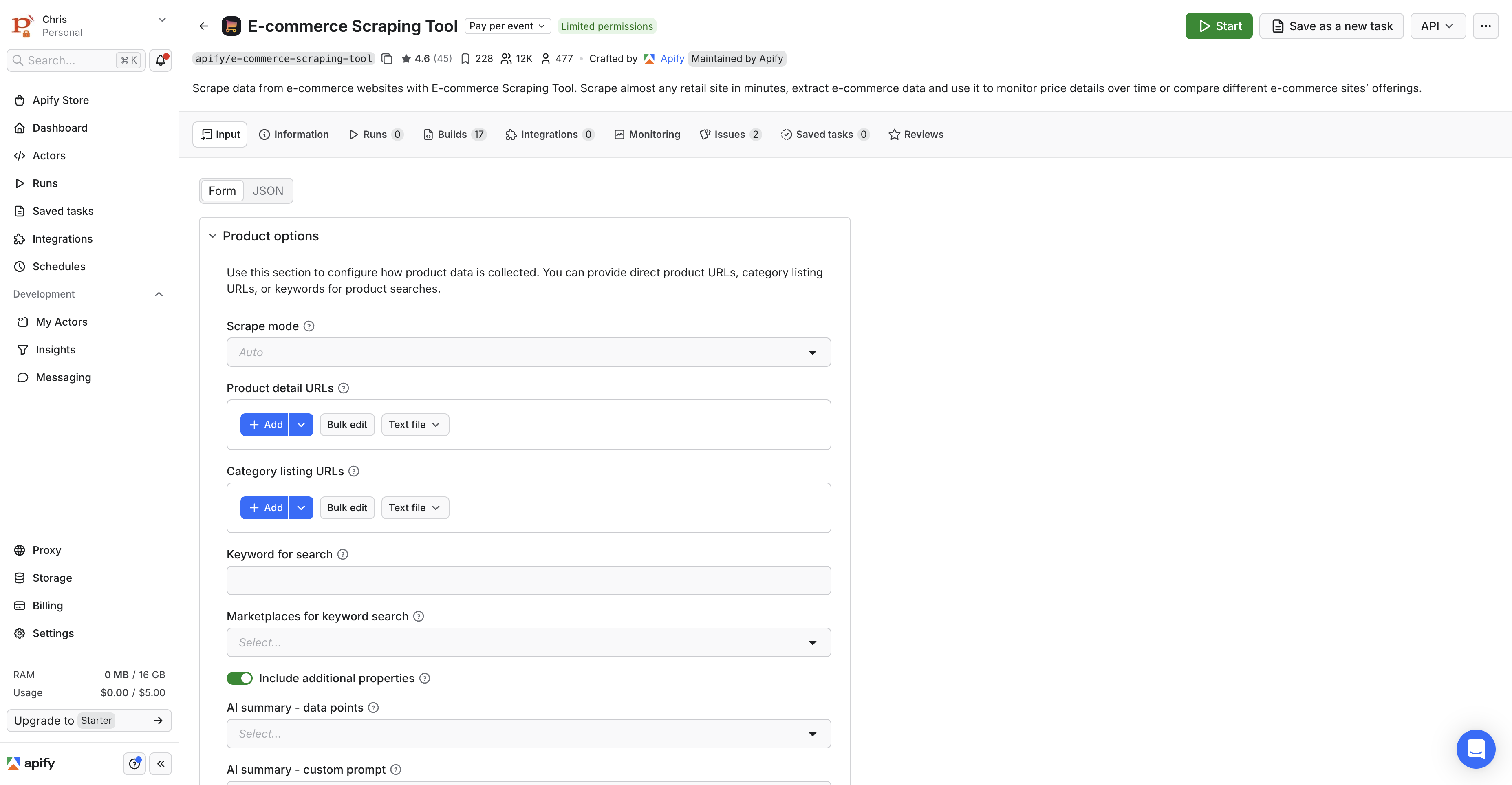
Apify's workflow is still actor-first. You open a detail page, inspect the input model, price, creator, rating, builds, issues, monitoring, and API tab, then decide whether that actor is good enough.
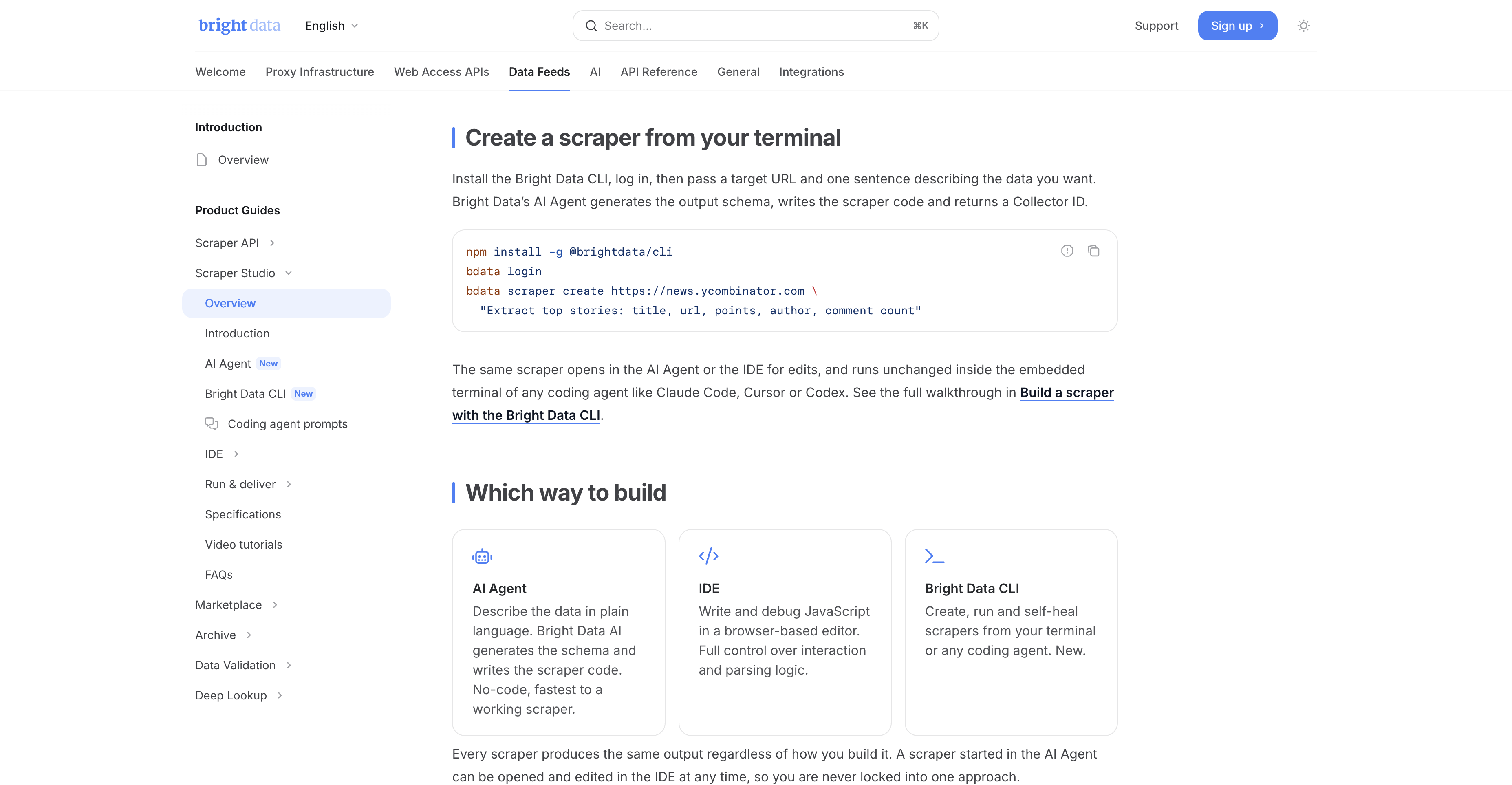
Bright Data's workflow is more product-first. You decide whether the site is already supported, whether Scraper Studio is needed, whether managed service is the cleaner handoff, and then you run that target on Bright Data's browser, proxy, and unblocking stack.
That is why I keep coming back to the same summary: Apify is more exploratory; Bright Data is more infrastructural.
One real output-shape example
Bright Data's real sample-output layer is another differentiator for buyer confidence because supported scrapers can be discussed as concrete data products instead of generic promises. A real Amazon-style product record from the sample-output pack includes fields like this:
{
  "title": "Wireless Noise Cancelling Headphones",
  "price": 249.99,
  "rating": 4.6,
  "reviews_count": 12450,
  "availability": "In Stock",
  "asin": "B0CHHSFMRL",
  "seller_name": "Electronics Hub",
  "brand": "SoundTech"
}
I am intentionally not pretending this is an apples-to-apples output proof against one exact Apify actor, because Apify's output shape depends on which actor you choose. That variability is part of the product story, not a footnote.
What teams often underestimate
Teams that like Apify often underestimate the long-run cost of comparing, swapping, and maintaining multiple actor choices across multiple sources. Teams that like Bright Data often underestimate how valuable the marketplace discovery model can be when the target is unusual and nobody wants to standardize on one workflow too early.
Neither bias is fatal, but both lead to bad buying decisions. That is why I do not think this page should end with “one winner.” It should end with the right winner for the right kind of buyer.
FAQ
Is Bright Data cheaper than Apify?
Not in one universal way. The cheaper option depends on the target, the billing unit, and whether the hidden cost is infrastructure ownership or tool exploration.
Is Apify better for niche sites?
Often yes when the buyer wants to search a marketplace of existing actors first. But if the team already knows the target and wants a more provider-managed route to production, Bright Data can still be the cleaner fit.
Should I compare Apify to Bright Data Scraper Studio or Bright Data Web Scraper API?
That depends on the target. If the site is already supported, compare Apify to Bright Data's maintained scraper layer first. If the site is unsupported, the more direct comparison is Apify versus Scraper Studio.
My decision shortcut
If the team starts from the sentence “we need data from this target and we do not want to own more infrastructure than necessary,” I usually lean Bright Data. If the team starts from the sentence “let's see what tools already exist for this source and test a few,” I usually lean Apify. That is the fastest honest shortcut I know for separating these two products without turning the whole comparison into vague platform marketing.
In other words, Bright Data usually wins when operational certainty matters more. Apify usually wins when exploratory choice matters more. That is the simplest buyer split on the page.
If a buyer cannot say which of those two priorities matters more, the safest next step is usually a small test on both sides rather than a bigger theoretical debate.
That kind of controlled trial usually teaches more than another hour of vendor marketing pages.
Who should choose which
Choose Bright Data if…
- You want one vendor that can cover supported scrapers, custom unsupported targets, datasets, and managed service under one roof.
- You care more about compliant access, managed infra, and lower long-run maintenance than about trying ten different store actors.
- You are buying for a business or data team that needs a stronger provider story than “we found an actor that works today.”
Choose Apify if…
- You want actor-marketplace exploration and do not mind comparing several tools before committing.
- You want a fast, low-friction way to test a target, especially when a creator may already have built something close to what you need.
- You value the Store, creator variety, and actor-level workflow more than a unified infrastructure-first product ladder.
When I would not use either in the same way
I would not use Bright Data Scraper Studio first for a target that Bright Data already supports through its ready scraper layer, because that shifts the buyer into unnecessary custom-workflow territory. I would also not use Apify as if marketplace breadth automatically means lower maintenance, because exploration and production simplicity are different benefits.
The supported-target exception
If the target is already supported, this is not only a “custom scraper versus custom scraper” decision anymore. That is where Bright Data's Web Scraper API re-enters the picture. For supported mainstream targets, I would often compare Bright Data's maintained scraper layer against Apify actor choice, not Scraper Studio against Apify actor choice.
That is exactly why the Web Scraper API vs Scraper Studio guide exists as a separate hub.
Final verdict
If your buying question is “What is the fastest way to discover and try a runnable scraping workflow?” Apify is often the better answer. If your buying question is “What is the cleaner long-run way to buy access, coverage, and infrastructure with less operational glue?” Bright Data is often the better answer.
That is the real comparison I trust: give me the tool versus give me the data stack.
Sources checked
- https://docs.brightdata.com/datasets/scraper-studio/overview
- https://docs.brightdata.com/datasets/scraper-studio/introduction
- https://docs.brightdata.com/datasets/scrapers/overview
- https://brightdata.com/products/web-scraper/studio
- https://console.apify.com/store
- https://console.apify.com/store-search?category=ECOMMERCE
- https://console.apify.com/store-search?search=linkedin
- https://console.apify.com/store-search?search=dm.de
- https://console.apify.com/actors/2APbAvDfNDOWXbkWf