Bright Data Scraper Studio is most compelling when the data you want is not in Bright Data's pre-built scraper library, but you still do not want to own the scraping infrastructure stack yourself.
Scraper Studio is easy to misunderstand because the marketing hook is “AI builds your scraper.” That is true, but it is not the main reason I would buy it.
The stronger reason is that Scraper Studio combines self-healing, hosted infrastructure, and code ownership in one product. You get an AI Agent, a browser IDE, and a CLI path, but the scraper still runs on Bright Data's managed proxy and unblocking stack instead of your own patchwork of browsers, proxies, retries, and monitoring scripts.
My rating in plain English
- Best for: unsupported sites, niche retail targets, local directories, and teams that still want to own scraper logic.
- Not best for: supported sites that already have a maintained Bright Data scraper.
- Also not best for: buyers who want a fully hands-off service and do not want to build anything at all.
Who this is for
I think Scraper Studio fits three types of buyer especially well:
- Developers who want to create a custom scraper without building their own proxy, browser, and unblocker layer.
- Operators who want a prompt-first starting point, but still need the option to edit code later in the IDE or CLI.
- Commercial teams chasing unsupported targets where pre-built scrapers do not yet exist.
If that sounds like your situation, this product is much easier to justify than a blank-page Selenium or Playwright stack plus separate proxies and anti-bot tooling.
What the real account evidence adds
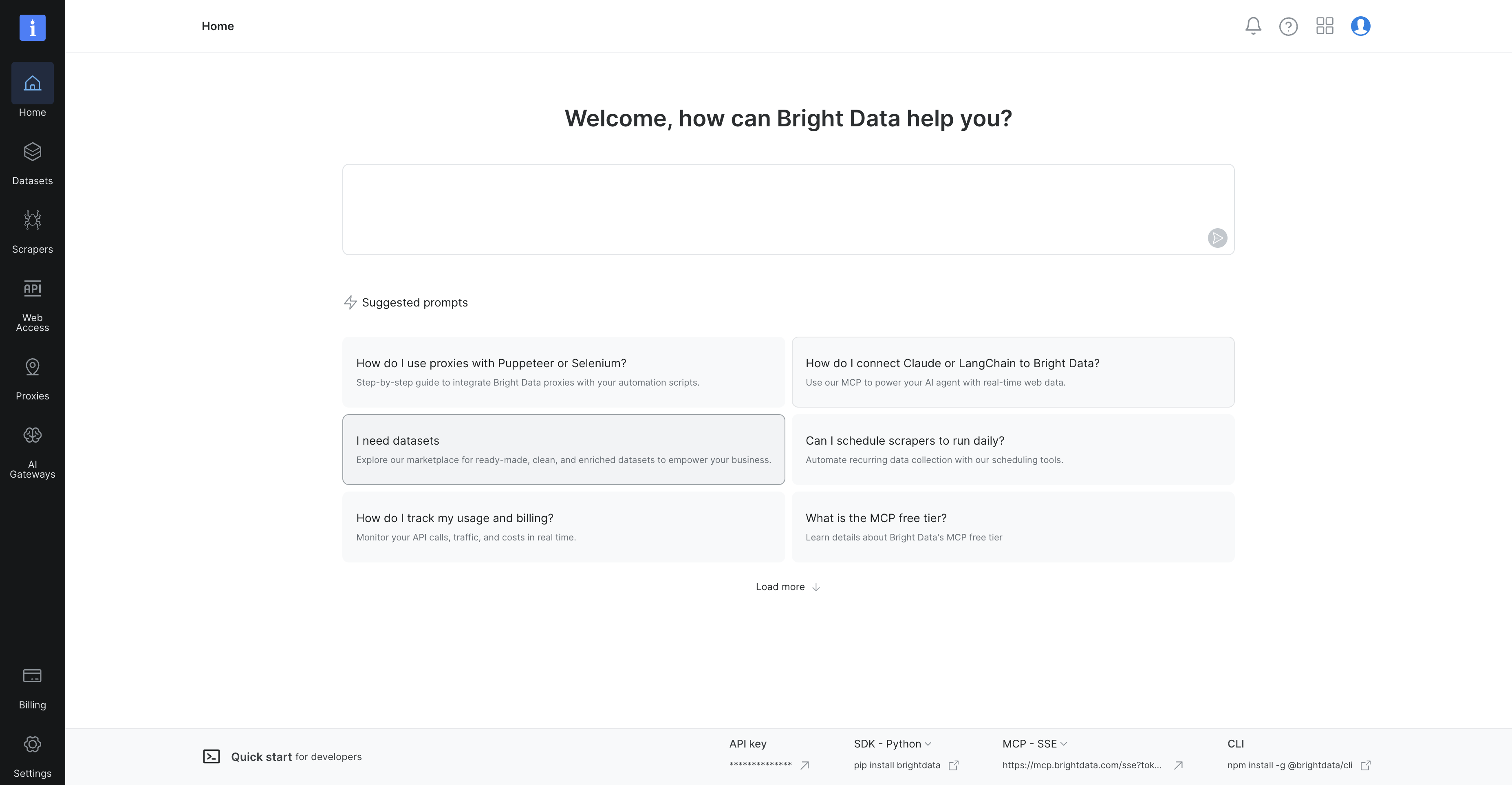
This is also one of those products where real-account evidence matters more than generic copy. In the funded Bright Data account used for this July 1, 2026 wave, the logged-in environment showed the current product taxonomy directly inside the control panel, and the account itself already held 21 active Scraper Studio scrapers.
That detail is useful because it proves Scraper Studio is not just a landing-page concept. It is an actively used product lane with real custom scrapers already running in the same account environment as the supported scraper library. For a review page, that is stronger first-hand experience than repeating the public hero copy and calling it a day.
- It confirms Bright Data itself treats Scraper Studio as an operational workflow, not only a marketing category.
- It confirms teams can keep multiple custom scrapers active in one managed environment.
- It makes the “hosted infra plus code ownership” pitch feel more believable because it is grounded in real account usage.
What actually makes Scraper Studio different
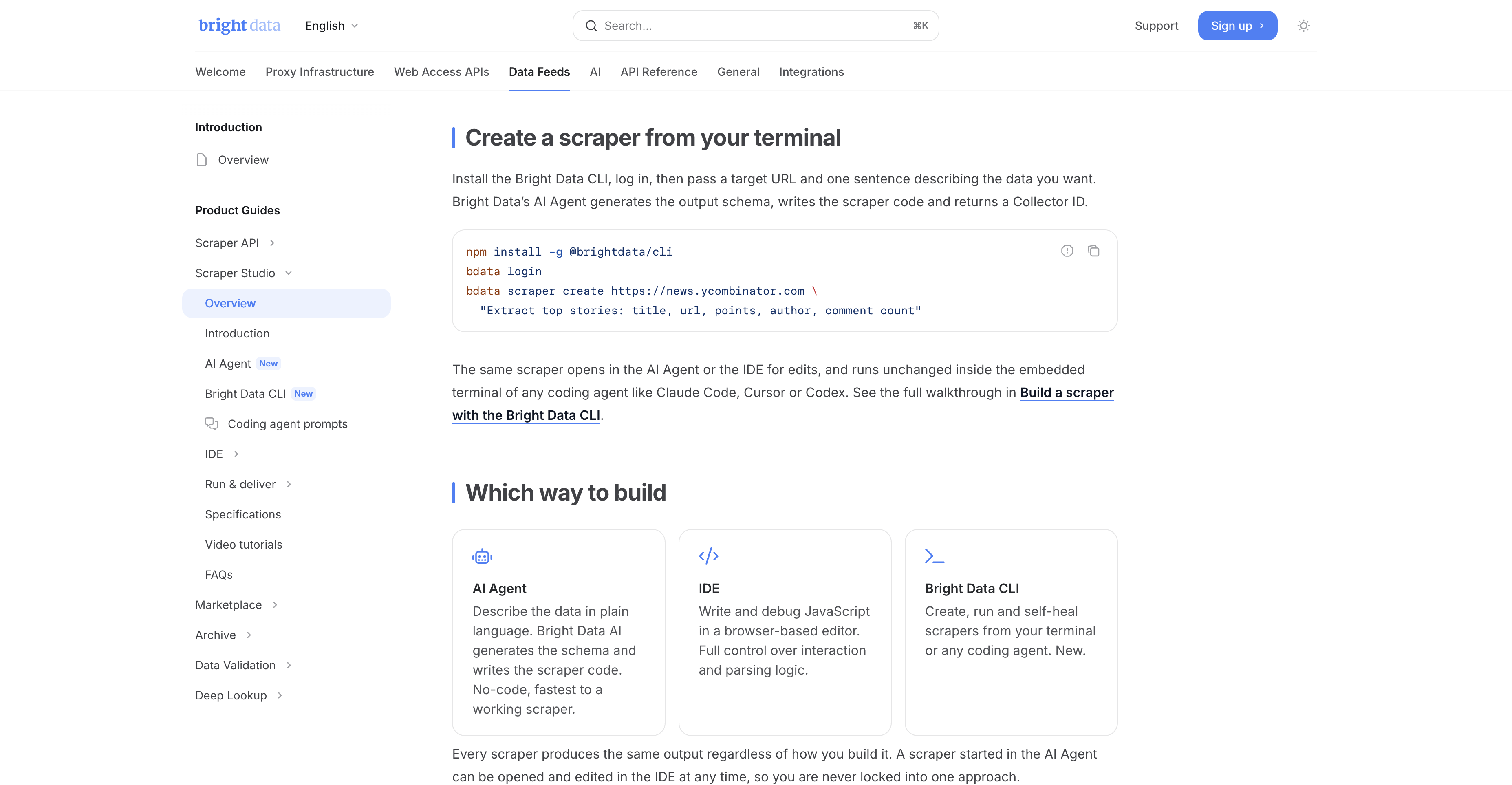
The real product story is not “Bright Data added AI.” The real product story is that the same custom scraper can be created in three different ways and still live on one hosted execution layer:
- AI Agent for the first version of the scraper.
- IDE for direct JavaScript edits and debugging.
- CLI for coding-agent and terminal-first workflows.
Bright Data's current docs explicitly show the terminal path with bdata scraper create <url> "<what to extract>". That matters because it means this is not a locked no-code toy. You can start with prompting, then move to code and API-based delivery when the workflow gets real.
The biggest selling point is not just AI generation
The highest-leverage differentiator is that Bright Data now frames Scraper Studio around self-healing. On the current product page, Bright Data emphasizes AI code fixes, fast schema updates, and lower maintenance when site structure changes.
That is a much stronger message than “write a scraper with a prompt.” Lots of tools can help draft a scraper. Fewer tools combine prompt-first setup with hosted execution, built-in unblocking, and an explicit maintenance story once the target site changes.
What a first successful build should actually look like
If I were evaluating Scraper Studio seriously, I would not judge it on whether one prompt produced one perfect scraper on the first try. I would judge it on whether the first usable build passes a more practical checklist:
- the output schema is explicit and stable enough to reuse
- the scraper can be triggered again without rebuilding it from scratch
- delivery works in a format the team can actually use
- the workflow still makes sense after the target changes once
That is where the combination of AI Agent, IDE, CLI, and self-healing becomes more valuable than a one-off demo. The point is not only generation speed. The point is whether the custom scraper stays maintainable after the first success.
| What I like | Why it matters |
|---|---|
| Hosted proxies, browsers, and unblocking | You avoid rebuilding the same scraping infrastructure stack around every custom target. |
| AI Agent plus IDE plus CLI | You can start fast, then move into code without changing products. |
| Self-healing positioning | Bright Data is trying to reduce the worst part of custom scraping: maintenance after the first successful run. |
| API-triggered delivery | You can run the scraper as part of a scheduled or application workflow, not only from the dashboard. |
Where I would be cautious
- I would not buy Scraper Studio first for a supported target when Bright Data already has a maintained scraper API for that domain.
- I would not sell it as a magic no-code answer for every target. You still need scraping judgment, schema discipline, and realistic expectations.
- I would not position it as a login-wall scraper. Bright Data's public product and FAQ language still keeps the product on publicly available data.
When I would not use Scraper Studio
I would not use Scraper Studio when the target is already covered cleanly by Bright Data's pre-built scraper layer, because that usually adds custom-workflow overhead without adding real value. I would also not use it when the team wants a fully hands-off engagement, because that is exactly where Bright Data's managed service fits better.
Pricing and free-tier reality
Free-tier note: Scraper Studio draws from Bright Data's 5,000-credit monthly web-data pool, and Studio runs consume one credit per page load.
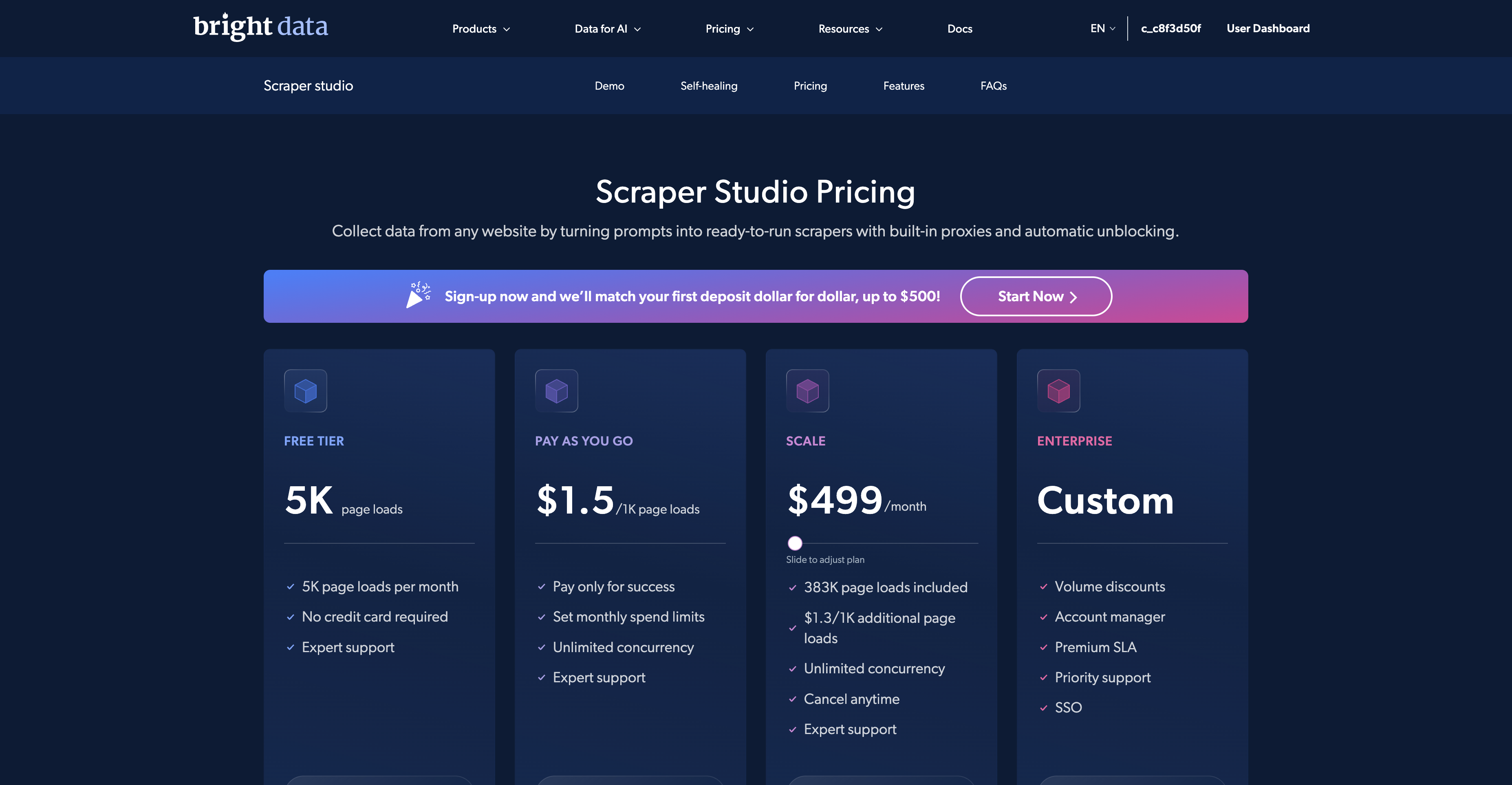
On July 1, 2026, Bright Data's public Scraper Studio pricing page shows:
- Free tier: 5K page loads per month
- PAYG: $1.5 / 1K page loads
Bright Data's billing docs add an important detail: the recurring free tier is a shared pool of 5,000 credits per month across Unlocker API, SERP API, Web Scraper API, and Scraper Studio. In that pool, Scraper Studio consumes one credit per page load.
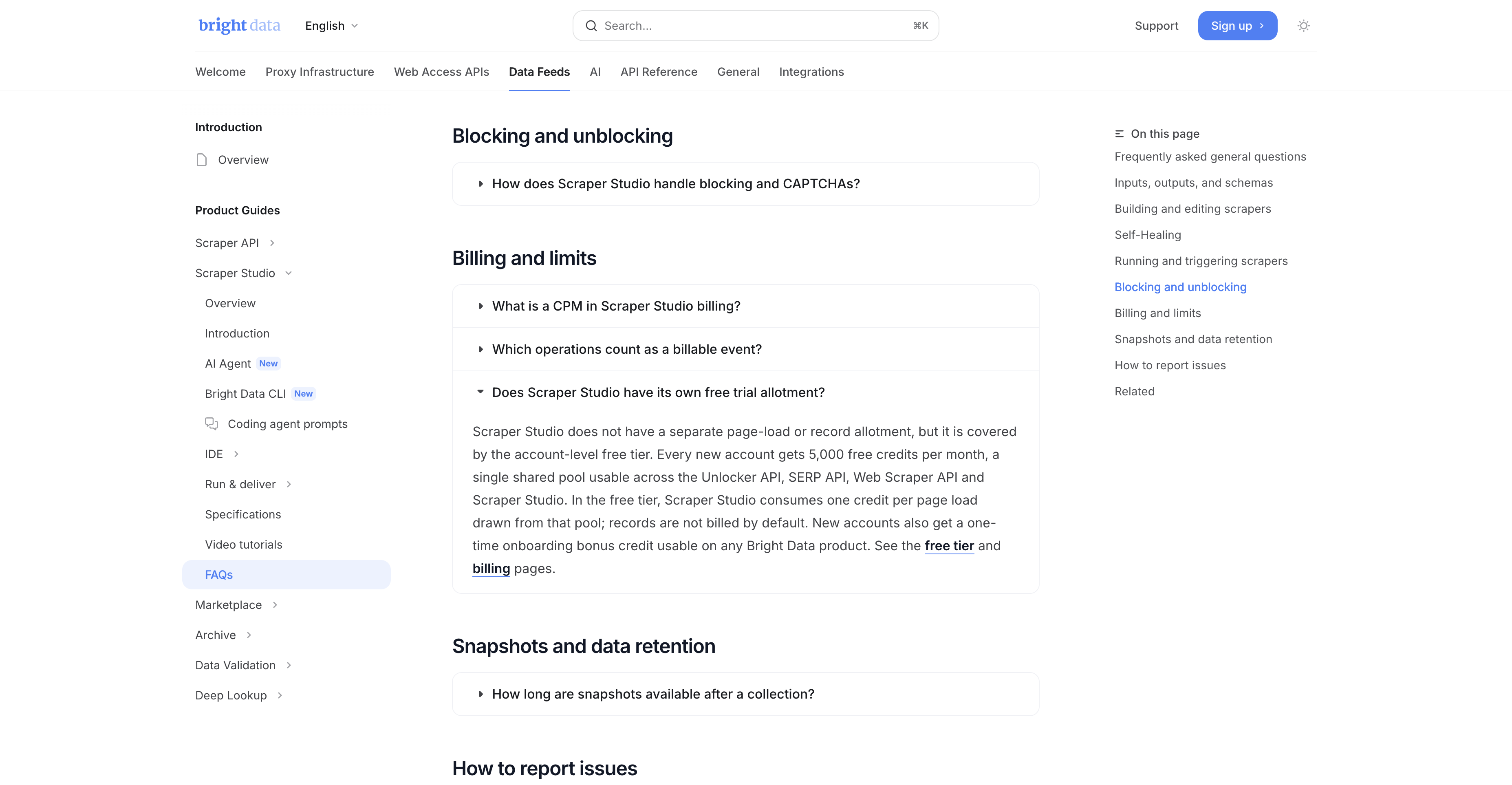
That means the free tier is useful for testing and light recurring runs, but you should think in page loads, not only in output rows.
How I would think about cost before buying
Most buyers compare Scraper Studio to another product page. I think the better comparison is usually Scraper Studio versus the hidden cost of building and keeping a custom scraper alive yourself.
If your team already owns a browser stack, proxy strategy, retries, alerting, and change-detection workflow, Scraper Studio may feel less essential. But if every unsupported target currently means a new ad hoc automation project, the cost comparison changes fast. A page-load price is not only a billing number; it is also a way to stop every new target from becoming its own infrastructure problem.
That is why the free tier and PAYG entry matter. They lower the cost of learning whether the target is worth operationalizing in the first place.
What the output and delivery side implies
Bright Data's docs do not position Scraper Studio as just a visual builder. They position it as a builder plus delivery system. The product can trigger runs and return structured output, and the broader docs keep pointing toward delivery options that fit real workflows rather than one-time browser inspection.
For me, that is another sign the product is meant for recurring data collection, not only experimentation. If the buyer needs JSON or CSV outputs on a repeatable schedule, Scraper Studio makes more sense than a loose pile of scripts with no shared managed execution layer.
What I would use instead in other cases
Use Bright Data Web Scraper API instead
If the site is already supported, Bright Data's pre-built scraper layer is usually the better first move. It is faster, simpler, and does not force you to open a custom scraper project unless you actually need one.
Use Managed Service instead
If your team is short on engineering time or simply does not want to own scraper operations, Bright Data's managed service is the cleaner answer. That is the right path when your real job is the data outcome, not the build workflow.
Use Apify instead
If you want a broader actor marketplace, more third-party workflow exploration, or a platform built around discovering and combining actors, then Apify remains a credible alternative. I cover that split in more detail in the full Bright Data vs Apify comparison.
Common mistake buyers make here
The usual mistake is assuming that “custom scraper” always means “I need to build everything myself.” That is not what Scraper Studio is selling. Bright Data is trying to sell a narrower custom problem: you own the scraper logic, while Bright Data owns more of the infrastructure burden underneath it.
The second mistake is assuming the reverse: that AI generation makes the maintenance problem disappear. It does not. It only changes the shape of the maintenance problem. That is why I keep putting so much weight on the self-healing angle. Without a believable maintenance story, this product would be much less compelling.
My buyer summary
If you are comparing Bright Data Scraper Studio to generic DIY scraping, the question is whether you want to keep solving unsupported-target access, rendering, and stability the hard way. If you are comparing it to Bright Data's supported scraper layer, the question is whether the target truly needs custom treatment. If you are comparing it to a marketplace like Apify, the question is whether you value exploratory tool choice more than a cleaner provider-led route to production.
That three-way decision is the real review, and it is why I still think the product's best fit is unsupported public-web targets for teams that want ownership of the scraper logic without full ownership of the infrastructure stack.
FAQ
Is Scraper Studio better than Bright Data's normal Web Scraper API?
Only when the target really needs custom coverage. For supported sites, the maintained scraper layer is still the easier first choice.
Does Scraper Studio remove the need for scraping knowledge?
No. It reduces build friction, but it does not remove the need to think clearly about schemas, target scope, delivery, and maintenance.
Is the free tier enough to evaluate it?
Usually yes for an initial proof-of-concept. The 5K page-load free tier is enough to tell whether an unsupported-target workflow is operationally useful before you scale it.
If I had to compress the review into one buying test, it would be this: can the team take one unsupported public-web target from idea to stable structured output without rebuilding the infrastructure stack from scratch? If the answer is yes, Scraper Studio has probably earned its place.
That is why my review remains positive but bounded. The product is strongest when the buyer already understands the target and wants the operational path to be cleaner than full DIY.
Final verdict
Bright Data Scraper Studio is not the best Bright Data product for every scraper buyer. It is the best Bright Data product for the specific buyer who needs custom coverage on unsupported public-web targets, wants to keep ownership of the scraper logic, and does not want to own the underlying proxy and browser stack.
That is why I see its real value as self-healing + hosted infra + code ownership, not just AI-assisted scraper generation.
Sources checked
- https://docs.brightdata.com/datasets/scraper-studio/overview
- https://docs.brightdata.com/datasets/scraper-studio/introduction
- https://docs.brightdata.com/datasets/scraper-studio/quickstart
- https://docs.brightdata.com/datasets/scraper-studio/faqs
- https://docs.brightdata.com/general/account/billing-and-pricing/free-tier
- https://brightdata.com/products/web-scraper/studio
- https://brightdata.com/products/managed-service