Discover the best machine learning and AI datasets. From image recognition to natural language processing, find curated, high-quality data sources to power your next breakthrough project. Includes free and premium options for researchers and enterprises.

2026 refresh: close the information gap first
The 2026 information gap here is that AI data buyers still treat datasets, scraper APIs, browser automation, managed collection, and raw proxies as if they were interchangeable line items.
What I use this page to decide now
- whether the reader needs prebuilt data or collection infrastructure
- whether freshness and geography matter more than bulk volume
- whether the workflow is blocked by extraction logic instead of routing
- whether a managed collection service is cheaper than stitching together proxy and scraper tooling
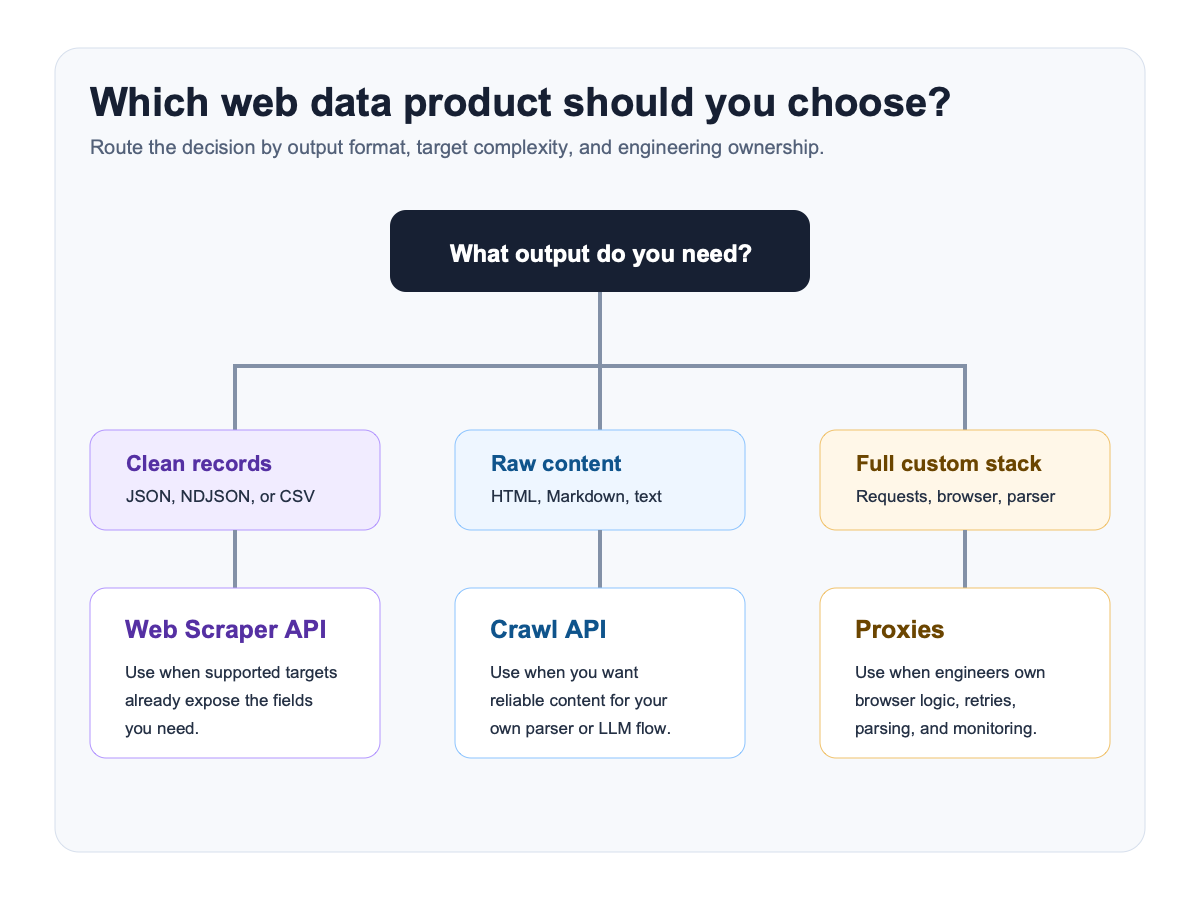
Access-layer decision matrix
| Need | Best starting layer | What it answers | What it does not prove |
|---|---|---|---|
| Fast model prototyping | Prebuilt datasets | Whether the team can start training or evaluation without building collection infrastructure first | That the dataset is fresh enough for every production use case |
| Ongoing coverage on changing sites | Managed collection or scraper API | Whether the supplier can keep the feed current and structured | That raw proxies alone will keep extraction stable |
| Blocked or JS-heavy targets | Browser or unlocker layer | Whether rendering, challenge handling, or session persistence is the real blocker | That a bigger proxy pool solves the workflow by itself |
| Country-aware observations | Residential or ISP proxies | Whether language, currency, stock, or public-web content changes by market | That one country result grants long-term account or billing rights |
What I would buy first
| Reader goal | I start with | Reason |
|---|---|---|
| Benchmarking or fast prototyping | Prebuilt datasets | They reduce time-to-first-model when freshness is not the only requirement. |
| Recurring production updates on changing targets | Managed collection or scraper API | Freshness and schema stability matter more than a one-time dump. |
| Geo-sensitive or localized observations | Residential or ISP proxy QA | It helps validate what changes by market before building the bigger pipeline. |
| Highly blocked or JS-heavy sources | Browser or unlocker layer | The real blocker is collection mechanics, not the dataset concept itself. |
What I will not promise
- Do not assume a prebuilt dataset is automatically current, rights-clean, or geo-complete enough for training.
- Do not sell raw proxies as the fastest path when the reader really needs structured or managed collection.
- Do not ignore licensing, refresh cadence, entity resolution, and PII handling just because the source list looks rich.
See the training-data proxy guide
“Garbage in, garbage out” is a classic AI truth: even the smartest algorithm depends on the quality of its data. High-quality datasets are essential—they turn theory into real-world AI that can see, listen, predict, and act. Today, finding data is easy; finding the right data is tough, with so many options available.
For this guide, I’ve chosen datasets based on diversity, popularity, relevance, and accessibility. Whether you’re into computer vision, NLP, autonomous tech, or healthcare, you’ll find the key datasets driving innovation—ranging from free resources for learning to premium, enterprise-grade data powering commercial AI.
How to Choose the Right Dataset for Your Project
Selecting the right dataset is like choosing the right foundation for a house – get it wrong, and everything built on top becomes unstable.
- Begin with your use case: Choose data that fits your project’s specific needs.
- Prioritize quality over size: A small, well-labeled, diverse dataset is better than a large, noisy one. Choose data with clear documentation and consistent labels.
- Evaluate diversity and representation: Your model’s fairness depends on its training data—make sure it reflects real-world scenarios and diverse users.
- Review licensing and compliance: Some datasets need special permissions or have usage restrictions, especially for commercial projects.
- Consider preprocessing: Some datasets need cleaning, others are ready-to-use. Plan for this in your timeline; well-maintained sets often include helpful scripts.
- Look for active community support: Choose datasets with active communities for better documentation, updates, and benchmarks.
Top 30 Datasets for ML & AI Models
1. Bright Data
Free-tier note: Bright Data's 5,000 monthly credits apply to Web Unlocker API, SERP API, Web Scraper API, and Scraper Studio; proxy bandwidth and Browser API are outside that recurring pool.
Best for: Commercial AI applications requiring fresh, diverse data

Bright Data is a leading and highly trusted dataset marketplace, relied on by Fortune 500 companies and over 20,000 customers worldwide. Renowned for delivering fresh, ethically sourced data, Bright Data stands out with real-time updates across business, e-commerce, social media, and financial sectors.
Its diverse catalog allows users to choose from pre-built, standardized datasets or request custom solutions tailored to specific requirements. This makes Bright Data an ideal choice for commercial AI applications that demand up-to-date and varied data sources.
In addition to its rich data catalog, Bright Data is a top provider of proxy services and web scraping APIs, supporting multiple formats like JSON, CSV, and Parquet, with flexible delivery options via API and major cloud platforms. Rigorous data validation and strict compliance with GDPR and CCPA ensure consistently high data quality.
Pricing begins at $600 per month or $250 for a one-time purchase for marketplace datasets, and $300 per month or $1000 one-time for custom datasets, with free samples available for evaluation.
2. Kaggle
Best for: Learning, experimentation, and competition participation

Kaggle is best known for its data science competitions, but its extensive dataset repository is equally noteworthy. With thousands of datasets contributed by a vibrant global community, Kaggle provides valuable resources for nearly any machine learning project. These community datasets are freely accessible, making Kaggle an essential destination for data exploration and experimentation.
The platform's strength lies in its community-driven approach. Datasets come with detailed descriptions, usage examples, and often include starter notebooks from other users. This makes Kaggle particularly valuable for learning and experimentation.
Popular datasets include the Titanic dataset for classification problems, housing prices for regression, and digit recognition for computer vision. The platform also hosts cutting-edge datasets from research institutions and companies launching data science challenges.
3. Datarade
Best for: Enterprise AI projects requiring verified, compliant data

Datarade serves as a comprehensive marketplace connecting data buyers with providers, offering access to over 400 premium machine learning datasets for commercial use. What sets Datarade apart is its strong emphasis on data quality and compliance—each dataset is verified, and many are GDPR-compliant. The platform features detailed metadata, sample previews, and transparent pricing to help users make informed decisions.
Datarade’s catalog covers a broad range of AI and ML training datasets, from consumer insights to B2B profiles, available through both one-time purchases and subscription models. Advanced filtering options make it easy to find datasets by geography, data type, and specific use case. Pricing varies by dataset provider.
4. Statista
Best for: Market analysis, economic modeling, and business intelligence

While primarily known for market research, Statista's vast database of statistical information provides excellent datasets for economic modeling, trend analysis, and business intelligence applications.
Their datasets cover global markets, consumer behavior, demographic trends, and industry statistics. The data comes pre-processed and often includes historical trends, making it perfect for time-series analysis and forecasting models.
Statista's strength lies in their rigorous data collection methodology and professional presentation. Each dataset includes source information, collection methods, and relevant context that's often missing from other sources. Pricing starts at $199 per month.
5. UCI Machine Learning Repository
Best for: Academic research, algorithm benchmarking, and education

The UCI Machine Learning Repository has been a foundational resource for the ML community since 1987. Featuring over 600 datasets, it remains one of the most frequently cited sources in machine learning research. All datasets are freely available for academic use.
UCI's datasets are meticulously documented and have been used in countless research papers, making them perfect for comparing new algorithms against established benchmarks. The repository includes classic datasets like Iris for classification and Wine Quality for regression.
What makes UCI special is the educational value. Each dataset includes detailed descriptions of attributes, suggested tasks, and relevant papers. This makes it an excellent resource for students and researchers looking to understand fundamental ML concepts.
6. Zyte

Best for: Custom data needs and real-time web data extraction
Zyte excels at extracting custom datasets from web sources, making them ideal for obtaining specific data not available in standard collections. Their expertise in handling complex websites and overcoming anti-bot measures ensures delivery of clean, well-structured data. Pricing starts at $450 per month.
Their platform offers both ready-made datasets and custom data extraction services. This flexibility makes them particularly useful for competitive intelligence, market monitoring, and unique research projects that require specific data sources.
Zyte's datasets are particularly strong in e-commerce, news, and business intelligence. They can handle dynamic websites, JavaScript-heavy pages, and sites with complex navigation structures that would challenge traditional scraping tools.
7. AWS Data Exchange
Best for: AWS-based projects and applications requiring cloud integration

Amazon Data Exchange streamlines dataset acquisition by leveraging the power of cloud computing. Hosting thousands of datasets from top providers, the platform offers seamless integration with AWS services for easy access and deployment. Pricing varies by dataset provider.
The strength of AWS Data Exchange lies in its integration with the broader AWS ecosystem. You can easily move data into S3, process it with SageMaker, or analyze it with Redshift. This reduces the technical overhead of data management significantly.
Datasets range from financial markets and healthcare to geospatial and demographic data. Many providers offer real-time data feeds, making it perfect for applications requiring up-to-date information.
8. Coresignal
Best for: B2B AI applications, recruitment technology, and sales intelligence

Coresignal specializes in B2B datasets, providing comprehensive information about companies, professionals, and job markets. Their data powers recruitment AI, sales intelligence, and market research applications.
What sets Coresignal apart is their focus on professional networks and career data. They provide insights into company growth, employee movements, and industry trends that are difficult to find elsewhere.
Their datasets are particularly valuable for building AI models that understand professional relationships, predict company performance, or identify market opportunities. The data quality is consistently high, with regular updates and verification processes. Pricing starting from $1000/month.
9. Google Dataset Search
Best for: Dataset discovery and research across diverse domains

Google Dataset Search is like Google Search, but specifically for datasets. As an open-source tool, it indexes millions of datasets from across the web, making it an invaluable resource for uncovering data sources that might otherwise remain hidden.
The platform doesn't host datasets itself but provides a unified way to search across repositories, government sites, academic institutions, and other data providers. Each result includes metadata about the dataset, its source, and how to access it.
What makes Dataset Search particularly powerful is its ability to find specialized datasets for niche applications. Whether you're looking for historical weather data or specific medical imaging datasets, chances are Dataset Search can help you find it.
10. ImageNet
Best for: Computer vision research, transfer learning, and image classification

ImageNet transformed computer vision and stands as one of the most influential datasets in AI history. Featuring over 14 million annotated images spanning thousands of categories, it established the benchmark for large-scale image classification. Access is free for non-commercial research use.
The ImageNet challenge spawned breakthrough architectures like AlexNet, VGG, and ResNet. These models, pre-trained on ImageNet, continue to serve as the foundation for countless computer vision applications through transfer learning.
What makes ImageNet special isn't just its size, but its systematic organization and high-quality annotations. The dataset follows a hierarchical structure based on WordNet, providing rich semantic relationships between categories.
11. Iris Dataset
Best for: Machine learning education and algorithm testing

The Iris dataset might be small by today's standards, but it remains one of the most important datasets in machine learning education. This simple yet elegant dataset contains measurements of iris flowers across three species and is freely available to all.
What makes Iris invaluable is its simplicity and clarity. With just 150 samples and 4 features, it's perfect for understanding fundamental ML concepts without getting lost in complexity. It's become the “Hello World” of machine learning.
Despite its age, Iris continues to be relevant for teaching classification algorithms, data visualization, and statistical analysis. It's also useful for testing new algorithms quickly before moving to more complex datasets.
12. YouTube-8M
Best for: Video AI research, content understanding, and temporal modeling

YouTube-8M is one of the largest video understanding datasets, featuring millions of video clips with comprehensive annotations. Designed to advance research in video classification and temporal modeling, it is freely available for use.
The dataset includes pre-computed audio and visual features, making it accessible even without massive computational resources. This democratizes video AI research by removing the need to process raw video files.
YouTube-8M has been instrumental in advancing video understanding AI, from content moderation to automatic video tagging. The dataset's scale and diversity make it perfect for training robust video classification models.
13. BBC Datasets
Best for: Text classification, NLP education, and news analysis

The BBC dataset offers a clean, well-organized collection of news articles spanning multiple categories, available for free. It has become a widely used benchmark for text classification and natural language processing research.
What makes this dataset particularly valuable is its high-quality text and clear categorical structure. The articles are professionally written and cover diverse topics, making it excellent for training robust text classifiers.
The dataset's manageable size and clear structure make it perfect for educational purposes and rapid prototyping of NLP applications. It's also been used extensively in research papers, providing established benchmarks for comparison.
14. COCO Dataset
Best for: Object detection, image segmentation, and multi-task computer vision

The Common Objects in Context (COCO) dataset has become the gold standard for object detection, segmentation, and captioning tasks. It contains over 200,000 images with detailed annotations for 80 object categories.
COCO stands out for its comprehensive annotations and free accessibility. In addition to bounding boxes, it offers pixel-level segmentation masks, object relationships, and descriptive captions, enabling a wide range of computer vision research.
The dataset has driven advances in object detection architectures like YOLO, R-CNN, and Mask R-CNN. Its annual challenges continue to push the boundaries of computer vision research.
15. LAION
Best for: Text-to-image generation, multimodal AI, and generative model research

LAION (Large-scale Artificial Intelligence Open Network) has created some of the largest openly available image-text datasets, including LAION-5B with 5.85 billion image-text pairs. These datasets have been instrumental in training text-to-image models like Stable Diffusion.
What makes LAION revolutionary is its scale and openness. By making such massive datasets freely available, LAION has democratized access to the data needed for training state-of-the-art generative AI models.
The organization's datasets have enabled breakthrough applications in text-to-image generation, multimodal AI, and creative applications. Their work represents a significant contribution to open-source AI development.
16. Common Voice
Best for: Speech recognition, voice AI, and multilingual applications

Mozilla's Common Voice is the world's most diverse crowdsourced open speech dataset. It aims to make voice technology accessible to everyone by providing multilingual speech data that represents diverse accents and speaking patterns.
The dataset contains thousands of hours of validated speech data across multiple languages. What sets Common Voice apart is its focus on inclusivity – it specifically seeks to include underrepresented voices and languages that are often ignored by commercial datasets.
This community-driven approach has created a resource that's more representative of global linguistic diversity than proprietary alternatives. It's become essential for building inclusive voice AI systems.
17. Google's Open Images
Best for: Computer vision research, object detection, and visual relationship understanding

Open Images contains over 9 million images annotated across 6,000 categories, making it one of the most comprehensive image datasets available. The annotations include image-level labels, object bounding boxes, and visual relationships.
The dataset's strength lies in its diversity and annotation quality. Images are sourced from Flickr and represent a wide variety of scenes, objects, and contexts. The annotations are verified through multiple quality control processes.
Open Images has become a cornerstone for computer vision research, particularly for training models that need to understand complex visual scenes and relationships between objects. Access is free.
18. Amazon Product Reviews
Best for: Sentiment analysis, recommendation systems, and e-commerce AI

This collection contains millions of Amazon product reviews spanning multiple categories and years. It's become one of the most widely used datasets for sentiment analysis and recommendation system research.
The dataset includes review text, ratings, product metadata, and user information. This richness enables research in sentiment analysis, recommendation systems, and consumer behavior modeling.
What makes this dataset particularly valuable is its scale and real-world nature. Unlike synthetic or small-scale datasets, these reviews represent genuine consumer opinions and behaviors, making models trained on this data more applicable to real-world scenarios. You can free to access.
19. Waymo Open Dataset
Best for: Autonomous vehicle research, 3D object detection, and sensor fusion

Waymo's Open Dataset represents one of the most comprehensive collections of autonomous vehicle data available. It contains high-quality sensor data from Waymo's self-driving cars, including LiDAR, camera, and radar information. Access is free for research use.
The dataset includes diverse driving scenarios across different weather conditions, times of day, and geographic locations. Each scene is meticulously annotated with 3D bounding boxes for vehicles, pedestrians, cyclists, and other road users.
This dataset has become essential for advancing autonomous vehicle research, from perception algorithms to path planning. Its real-world complexity provides the challenges needed to develop robust self-driving systems.
20. LabelMe
Best for: Image segmentation, annotation tool development, and custom dataset creation

LabelMe provides a large collection of annotated free images along with an annotation tool for creating custom datasets. The original dataset contains thousands of images with detailed object outlines and labels.
What makes LabelMe special is its dual nature – it's both a dataset and a tool for creating new datasets. The annotation tool is widely used in the computer vision community for creating custom annotations.
The dataset's annotations are particularly detailed, with precise object boundaries rather than simple bounding boxes. This level of detail has made it valuable for segmentation and fine-grained recognition tasks.
21. LibriSpeech
Best for: Speech recognition research, acoustic modeling, and benchmark comparisons

LibriSpeech is a large free corpus of English speech derived from audiobooks in the public domain. It contains approximately 1,000 hours of speech sampled at 16 kHz, making it one of the most substantial free speech recognition datasets available.
The dataset is organized by speaker and includes transcriptions aligned with the audio. The speech represents clean, well-enunciated English, making it excellent for training speech recognition models and studying acoustic modeling.
LibriSpeech has become a standard benchmark in speech recognition research. Many state-of-the-art speech recognition systems report results on LibriSpeech, making it easy to compare different approaches.
22. IMDB-Wiki
Best for: Age estimation, gender prediction, and facial analysis research

The IMDB-Wiki dataset features over 500,000 face images with age and gender labels sourced from IMDB and Wikipedia. As the largest free public dataset for age and gender prediction from facial images, it provides a valuable resource for related research.
What makes this dataset unique is its scale and real-world nature. The images come from professional photos and movie stills, representing a wide variety of ages, ethnicities, and photography conditions.
The dataset has been instrumental in advancing research in facial analysis, age estimation, and demographic prediction. It's particularly valuable for applications in entertainment, security, and demographic analysis.
23. Stanford Dogs Dataset
Best for: Fine-grained classification, breed recognition, and attention mechanism research

The Stanford Dogs dataset contains 20,580 images of dogs representing 120 breeds. It's designed for fine-grained image classification research, where the challenge is distinguishing between very similar categories.
Each image includes breed annotations and bounding box information. The dataset represents a challenging classification problem due to the high similarity between some dog breeds and the large variation within breeds.
This dataset is a standard benchmark for fine-grained recognition algorithms and has driven advances in attention mechanisms and feature learning for subtle visual distinctions. Access is free.
24. HealthData.gov
Best for: Public health research, epidemiological studies, and healthcare policy analysis

HealthData.gov serves as the central repository for U.S. government health datasets. It contains thousands of datasets covering public health, healthcare quality, epidemiology, and health services research.
The platform provides access to data from agencies like the CDC, FDA, and CMS. Datasets range from disease surveillance data to healthcare utilization statistics and clinical trial information.
HealthData.gov stands out for its authoritative, government-sourced datasets, making it a trusted resource for health information. These datasets are widely used in policy research and public health planning, and are freely accessible.
25. MIMIC-III Database
Best for: Healthcare AI, clinical prediction models, and medical research

MIMIC-III (Medical Information Mart for Intensive Care) is a large database containing de-identified health data from ICU patients. It includes demographics, vital signs, laboratory tests, medications, and more. Access is free with credentialed registration.
The database represents over 40,000 patients and provides a comprehensive view of critical care medicine. It's become essential for developing AI applications in healthcare, from mortality prediction to treatment optimization.
Access to MIMIC-III requires completing a training course and agreeing to strict data use agreements, reflecting the sensitive nature of healthcare data. This controlled access ensures responsible use while enabling groundbreaking research.
26. Global Fishing Watch
Best for: Maritime analysis, environmental monitoring, and supply chain tracking

Global Fishing Watch provides datasets on global fishing activity derived from satellite and vessel tracking data. Their mission is to increase transparency in marine environments and combat illegal fishing. It is free for research use.
The datasets include vessel movements, fishing activity patterns, and maritime traffic information. This data has applications in environmental monitoring, supply chain transparency, and maritime security.
What makes this dataset unique is its global scope and environmental focus. It represents a novel application of big data for ocean conservation and sustainable fishing practices.
27. ESC-50
Best for: Audio classification, environmental sound recognition, and acoustic scene analysis

ESC-50 is a free dataset for environmental sound classification consisting of 2,000 environmental audio recordings. The sounds are organized into 50 classes across 5 major categories: animals, natural soundscapes, human sounds, interior sounds, and urban sounds.
Each recording is 5 seconds long and the dataset is designed to provide a standardized benchmark for environmental sound classification research. The sounds represent everyday audio that might be encountered in real-world applications.
ESC-50 has become a standard benchmark in audio classification research and has contributed to advances in audio feature extraction and neural network architectures for sound recognition.
28. Yelp Open Dataset
Best for: Sentiment analysis, recommendation systems, and local business intelligence

The Yelp Open Dataset contains millions of user reviews, business attributes, and user data from Yelp3. It's widely used for sentiment analysis, recommendation systems, and business intelligence research.
The dataset includes review text, star ratings, business categories, and user information. This richness enables research in various areas from natural language processing to social network analysis.
What makes Yelp's dataset particularly valuable is its real-world nature and scale. The reviews represent genuine customer experiences across diverse businesses and locations, providing authentic data for training commercial applications.
29. LISA Traffic Sign Dataset
Best for: Autonomous vehicle research, traffic sign recognition, and safety-critical AI systems

The LISA Traffic Sign Dataset contains free information on traffic signs, vehicle detection, lights, and trajectory patterns. It's designed specifically for research in autonomous vehicle perception systems.
The dataset includes images of various traffic signs under different lighting conditions, weather, and viewing angles. This diversity is crucial for training robust traffic sign recognition systems that work reliably in real-world conditions.
LISA has contributed to advances in traffic sign detection algorithms and has been used to validate autonomous vehicle perception systems. Its focus on safety-critical applications makes data quality paramount.
30. World Bank Open Data
Best for: Economic analysis, development research, and global trend analysis

The World Bank's Open Data initiative provides free access to comprehensive development data covering population demographics, economic indicators, and social statistics from countries worldwide.
The datasets span decades of historical data, making them excellent for time-series analysis and economic modeling. Topics include poverty rates, education statistics, health indicators, and environmental data.
What makes World Bank data special is its standardization and global coverage. The data follows consistent methodologies across countries, enabling comparative analysis and global trend identification.
Tips for Handling Data Quality and Biases
Working with datasets isn't just about finding the right data – it's about understanding and mitigating the challenges that come with real-world information.
- Explore your data: Identify missing values, outliers, and biases through thorough exploration and visualization.
- Validate rigorously: Use cross-validation and stratified sampling to ensure robust, generalizable models—especially with imbalanced data.
- Watch for bias: Check that your dataset fairly represents all relevant groups and contexts.
- Document everything: Track data sources, preprocessing steps, and transformations for transparency and troubleshooting.
- Monitor for drift: Set up systems to detect changes in real-world data that could affect model performance.
- Consider ensembles: Combining models trained on different data subsets or preprocessing methods can help reduce bias and improve reliability.
Conclusion
The AI dataset landscape has never been more diverse or powerful. The ideal dataset isn’t necessarily the largest or most popular—it’s the one that best aligns with your project’s goals and ethical considerations.
Take the time to evaluate your options, prioritize data quality and fairness, and stay connected with the AI community. The right dataset can transform a promising idea into a true breakthrough. Choose thoughtfully!
2026 operator checklist
- Record whether the reader needs prebuilt data, managed collection, or a build-it-yourself pipeline.
- Check licensing, refresh cadence, and geography before claiming dataset quality.
- Separate evaluation data, training data, and monitoring data because they age differently.
- Use proxies for observation or collection routing, not as a substitute for data-quality review.
Related AI pages
- LLM Training Data Proxies for 2026
- How to Gather Training Data for Effective AI Models
- 10 Best Public Datasets for Machine Learning in 2026
- 10 Best Scraper APIs for Real-Time AI Data Feeds in 2026
- AI Proxies