Discover the top 10 public datasets for machine learning in 2026. From Kaggle to AWS Open Data Registry, find the perfect dataset for your AI projects with our expert guide to premium data sources.

2026 refresh: close the information gap first
The 2026 information gap here is that AI data buyers still treat datasets, scraper APIs, browser automation, managed collection, and raw proxies as if they were interchangeable line items.
What I use this page to decide now
- whether the reader needs prebuilt data or collection infrastructure
- whether freshness and geography matter more than bulk volume
- whether the workflow is blocked by extraction logic instead of routing
- whether a managed collection service is cheaper than stitching together proxy and scraper tooling
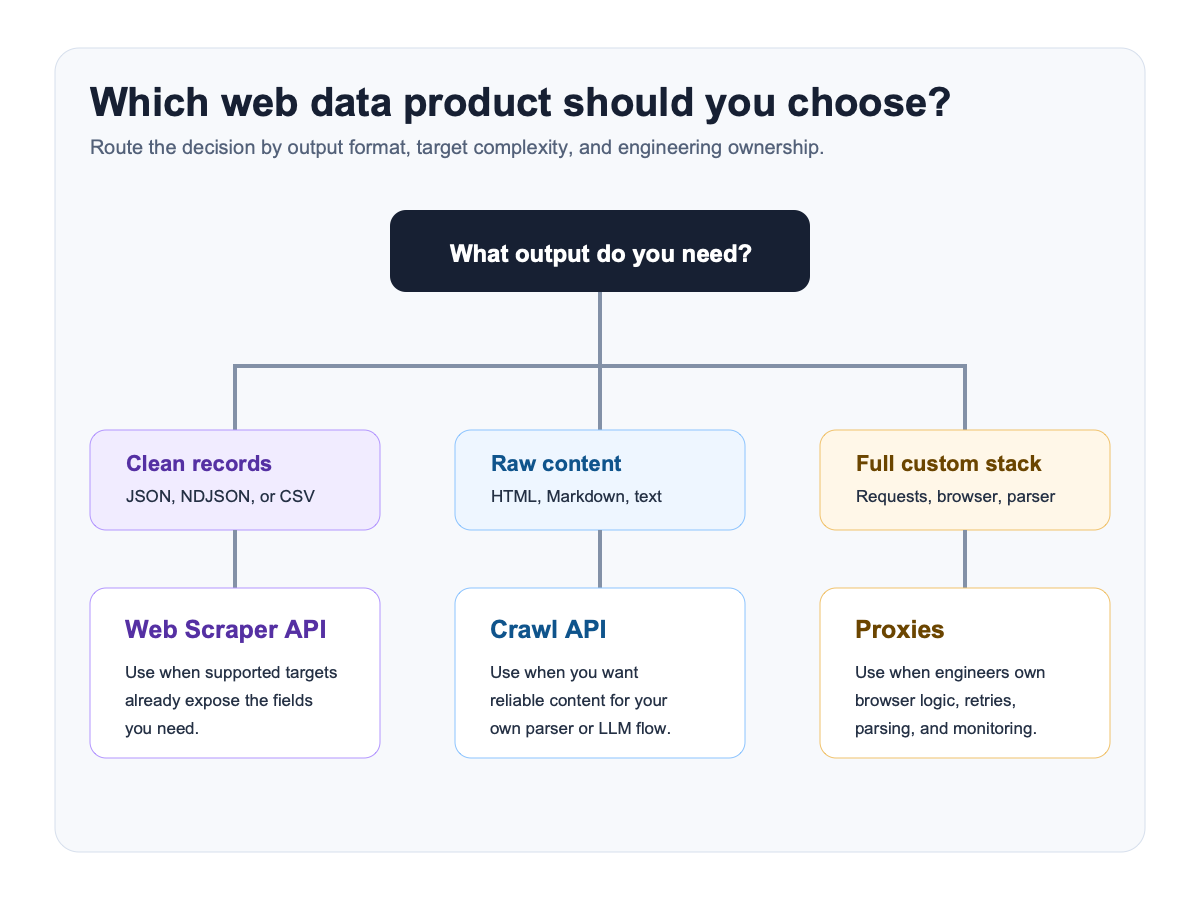
Access-layer decision matrix
| Need | Best starting layer | What it answers | What it does not prove |
|---|---|---|---|
| Fast model prototyping | Prebuilt datasets | Whether the team can start training or evaluation without building collection infrastructure first | That the dataset is fresh enough for every production use case |
| Ongoing coverage on changing sites | Managed collection or scraper API | Whether the supplier can keep the feed current and structured | That raw proxies alone will keep extraction stable |
| Blocked or JS-heavy targets | Browser or unlocker layer | Whether rendering, challenge handling, or session persistence is the real blocker | That a bigger proxy pool solves the workflow by itself |
| Country-aware observations | Residential or ISP proxies | Whether language, currency, stock, or public-web content changes by market | That one country result grants long-term account or billing rights |
What I would buy first
| Reader goal | I start with | Reason |
|---|---|---|
| Benchmarking or fast prototyping | Prebuilt datasets | They reduce time-to-first-model when freshness is not the only requirement. |
| Recurring production updates on changing targets | Managed collection or scraper API | Freshness and schema stability matter more than a one-time dump. |
| Geo-sensitive or localized observations | Residential or ISP proxy QA | It helps validate what changes by market before building the bigger pipeline. |
| Highly blocked or JS-heavy sources | Browser or unlocker layer | The real blocker is collection mechanics, not the dataset concept itself. |
What I will not promise
- Do not assume a prebuilt dataset is automatically current, rights-clean, or geo-complete enough for training.
- Do not sell raw proxies as the fastest path when the reader really needs structured or managed collection.
- Do not ignore licensing, refresh cadence, entity resolution, and PII handling just because the source list looks rich.
See the training-data proxy guide
You’ve got a groundbreaking machine learning idea that could revolutionize your industry—but there’s one big obstacle: you need large volumes of quality data. Sound familiar? You’re definitely not alone. The foundation of any successful machine learning model is the quality and relevance of its training data. Even the most sophisticated algorithms can’t deliver meaningful results without reliable datasets.
Fortunately, the public dataset landscape has evolved rapidly, offering unprecedented access to diverse, well-curated data sources for your AI projects. Yet with hundreds of repositories available, finding the perfect dataset can be overwhelming.
That’s where this guide comes in. With over a decade of experience helping organizations solve their data sourcing challenges, I’ll walk you through the most effective public datasets available today—so you can spend less time searching for data, and more time turning your ideas into reality.
1. Bright Data: AI-Powered Web Data at Scale
Free-tier note: For AI data workflows, Bright Data's monthly credits are best framed as a scoped web-data test pool for Web Unlocker, SERP API, Web Scraper API, and Scraper Studio; proxy products and Browser API are separate.
Best For: Organizations needing real-time data feeds, custom data collection projects, and large-scale AI training initiatives where data freshness is critical.

Let's start with a game-changer in the dataset space. Bright Data has revolutionized how we think about real-time data collection for AI applications. Their platform offers instant access to over 200 ready-to-use data packages specifically designed for machine learning and AI projects.
What makes Bright Data stand out is their AI-driven web scraping capabilities that deliver real-time, structured data at scale. Unlike static datasets that become outdated quickly, Bright Data provides continuous access to fresh web data across industries like e-commerce, finance, social media, and news.
Key Features:
- 200+ pre-built data packages ready for immediate use
- Real-time data extraction and updates
- Enterprise-grade infrastructure trusted by Fortune 500 companies
- Custom data collection services for specialized needs
- Advanced filtering and data structuring capabilities
Getting Started: Visit their AI data packages portal to explore industry-specific datasets or request custom data collection services tailored to your specific requirements.
2. Kaggle Datasets: The Community-Driven Powerhouse
Best For: Beginners learning ML, prototyping projects, competition participation, and accessing clean, ready-to-use datasets with community support.

If you're new to machine learning or looking to practice your skills, Kaggle remains the gold standard for accessible, diverse datasets. With over 50,000 public datasets spanning virtually every domain imaginable, it's like having a massive library of data at your fingertips.
What I love about Kaggle is its community aspect. You're not just downloading data – you're joining a vibrant ecosystem where data scientists share insights, create kernels (notebooks), and collaborate on solutions. The platform's built-in tools make it incredibly easy to explore, visualize, and experiment with datasets without leaving your browser.
Key Features:
- Massive collection of 50,000+ datasets
- Built-in Jupyter notebook environment
- Community discussions and shared code
- Competition datasets with benchmarks
- Easy data exploration and visualization tools
Pro Tip: Use Kaggle's search filters to find datasets by size, file type, or popularity. The “usability” score is particularly helpful for identifying well-documented datasets.
3. UCI Machine Learning Repository: The Academic Gold Standard
Best For: Academic research, algorithm benchmarking, educational purposes, and projects requiring established baselines for comparison.

The UCI Machine Learning Repository has been the academic community's go-to resource for over three decades, and for good reason1. This carefully curated collection focuses on benchmark datasets that have been thoroughly tested and validated by researchers worldwide.
What sets UCI apart is its scientific rigor4. Each dataset comes with detailed documentation, clear attribution, and established benchmarks that make it perfect for algorithm comparison and academic research. These aren't just random data collections – they're carefully chosen examples that represent specific machine learning challenges.
Key Features:
- Over 600 carefully curated datasets
- Extensive documentation and metadata
- Established benchmarks for algorithm comparison
- Academic peer review and validation
- Clear licensing and attribution requirements
Notable Datasets: The Iris dataset, Wine recognition data, and Adult income prediction dataset remain among the most cited in ML literature.
4. Data.gov: Government Data at Your Service
Best For: Economic analysis, demographic studies, urban planning, climate research, and any project requiring authoritative government statistics.

Here's something many people overlook: the U.S. government is one of the world's largest data producers, and most of it is freely available through Data.gov. This platform provides access to over 250,000 datasets from federal, state, and local government agencies.
The beauty of government data lies in its comprehensiveness and reliability. When you're working with census data, economic indicators, climate information, or transportation statistics, you're accessing datasets that have been collected systematically over decades with rigorous quality controls.
Key Features:
- 250,000+ datasets across multiple domains
- High-quality, systematically collected data
- Long-term historical records
- Regular updates and maintenance
- Multiple format options (CSV, JSON, XML, APIs)
Hidden Gem: Don't miss the linked international open data portals – Data.gov connects you to similar repositories from cities, states, and countries worldwide.
5. AWS Open Data Registry: Cloud-Scale Data Access
Best For: Large-scale ML projects, cloud-native applications, organizations already using AWS infrastructure, and projects requiring massive computational resources.

Amazon's Open Data Registry is a treasure trove for organizations working with large-scale data15. Through the AWS Open Data Sponsorship Program, they're hosting over 300 petabytes of high-value, cloud-optimized datasets that you can access directly within AWS infrastructure.
What's particularly powerful about this approach is the seamless integration with AWS services. You can directly feed these datasets into Amazon SageMaker for model training, use them with AWS Glue for data processing, or analyze them with Amazon Athena – all without worrying about data transfer costs or bandwidth limitations.
Key Features:
- 300+ petabytes of cloud-optimized data
- Direct integration with AWS ML services
- No data transfer costs for analysis within AWS
- Datasets spanning climate, genomics, satellite imagery, and more
- Regular updates with new and refreshed datasets
Recent Additions: AWS continuously adds new datasets, with 66 new or updated datasets added recently across climate, geospatial, life sciences, and machine learning categories.
6. Google Dataset Search: Your Universal Data Discovery Engine
Best For: Discovering niche datasets, comprehensive data exploration, and finding datasets that might not be available on major platforms.

Think of Google Dataset Search as the Google search engine specifically designed for finding datasets. Instead of manually browsing through different repositories, you can search across thousands of dataset providers simultaneously using natural language queries.
This tool is particularly valuable when you're looking for niche or specialized datasets. It indexes datasets from academic institutions, government agencies, news organizations, and other data publishers, giving you a comprehensive view of what's available across the entire web.
Key Features:
- Search across thousands of dataset repositories
- Natural language query support
- Filter by usage rights, file format, and update frequency
- Direct links to original dataset sources
- Integration with Google Cloud Platform for analysis
Search Strategy: Use specific domain terms combined with data types (e.g., “customer sentiment analysis text data” or “medical imaging pneumonia datasets”) for better results.
7. Azure Open Datasets: Microsoft's Curated Collection
Best For: Organizations using Microsoft Azure infrastructure, projects requiring reliable data feeds, and applications needing weather, demographic, or temporal data.

Microsoft's Azure Open Datasets takes a curated approach to public data, focusing on quality over quantity. These datasets are specifically chosen and cleaned to work seamlessly with Azure Machine Learning services, saving you significant preprocessing time.
What I appreciate about Azure's approach is their emphasis on data readiness. These aren't raw datasets that require extensive cleaning – they're production-ready data sources that you can immediately use for model training and analysis.
Key Features:
- Curated and pre-cleaned datasets
- Seamless integration with Azure ML services
- Focus on commonly needed data types (weather, demographics, holidays)
- Regular maintenance and updates
- Enterprise-grade security and compliance
Standout Categories: Weather data, public holidays, census information, and safety statistics are particularly well-maintained and comprehensive.
8. Meta AI: Research-Grade Datasets from Industry Leaders
Best For: Advanced research projects, benchmark comparisons, computer vision applications, and NLP model development.

Meta AI's dataset collection represents some of the most advanced research in computer vision, natural language processing, and social network analysis. These datasets often accompany groundbreaking research papers and provide access to data that would be impossible to collect independently.
The quality and scale of Meta's datasets are exceptional, reflecting their access to billions of users and advanced data collection infrastructure. Many of these datasets have become benchmarks in their respective fields.
Key Features:
- Research-grade quality and scale
- Cutting-edge computer vision and NLP datasets
- Benchmark datasets used in academic competitions
- Extensive documentation and research context
- Regular updates aligned with research publications
Notable Contributions: Datasets for object detection, image segmentation, language translation, and social network analysis that have shaped modern AI research.
9. AI2 Open Data: Research-Driven Datasets for AI Advancement
Best For: Academic research, benchmarks, advanced NLP, scientific reasoning, and educational use.

The Allen Institute for AI (AI2) represents one of the most prestigious sources of research-grade datasets in the artificial intelligence community. As a leading research institution focused on advancing AI for the common good, AI2 has created numerous benchmark datasets that have shaped the landscape of natural language processing, computer vision, and machine learning research.
What sets AI2 apart is their commitment to creating datasets that address fundamental AI challenges. Rather than simply collecting data, they focus on datasets that test specific capabilities like reasoning, reading comprehension, and common sense understanding. These datasets often accompany groundbreaking research papers and serve as benchmarks that drive the entire field forward.
Key Features:
-
- Research-grade datasets designed to test specific AI capabilities
- Comprehensive benchmarks for reading comprehension and reasoning
- Strong integration with academic research and publications
- High-quality annotations and rigorous validation processes
- Active maintenance and community support through Hugging Face
Getting Started: Visit their dedicated open data page or explore their comprehensive collection on Hugging Face to find datasets aligned with your specific research goals and evaluation needs.
10. OpenML: The Collaborative Science Platform
Best For: Academic research, algorithm comparison studies, educational projects, and collaborative ML research initiatives.

OpenML takes a unique approach to dataset sharing by combining data with machine learning experiments and results. It's not just a dataset repository – it's a platform for collaborative machine learning research where you can see how different algorithms perform on the same datasets.
This collaborative aspect makes OpenML incredibly valuable for understanding dataset characteristics and choosing appropriate algorithms. You can see which models work best for similar problems and learn from the community's collective experience.
Key Features:
- Integration of datasets, algorithms, and results
- Collaborative research environment
- Automated experiment tracking and comparison
- Educational resources and tutorials
- Scientific rigor and peer review processes
Frequently Asked Questions
How do I choose between free and paid datasets?
Start with free datasets for prototyping and proof-of-concept work. Consider paid datasets when you need specialized data, guaranteed quality, or ongoing updates for production systems.
What's the minimum dataset size for effective machine learning?
It depends on your problem complexity, but generally aim for at least 1,000 examples per class for simple problems, and 10,000+ for complex tasks like image recognition.
How can I verify dataset quality before using it?
Look for proper documentation, community reviews, established benchmarks, and clear provenance. Always perform exploratory data analysis before committing to a dataset.
Can I combine multiple public datasets?
Yes, but ensure license compatibility and be careful about data consistency when merging sources. Document your combination process for reproducibility.
Conclusion
From Bright Data’s real-time web intelligence to UCI’s academic benchmarks, government repositories, and cutting-edge research datasets, you now have unprecedented access to high-quality data. Success in machine learning isn’t just about finding data—it’s about selecting the right dataset for your specific challenge and leveraging it effectively.
Choose platforms that align with your skills and project needs. Kaggle and UCI are great starting points for beginners, while AWS and Azure shine for cloud-native solutions. For specialized projects, harness Bright Data’s real-time insights or Meta AI’s advanced research collections.
Ready to launch your next ML project? Bookmark this guide and start exploring these top dataset resources—the world of AI is yours to discover.
2026 operator checklist
- Record whether the reader needs prebuilt data, managed collection, or a build-it-yourself pipeline.
- Check licensing, refresh cadence, and geography before claiming dataset quality.
- Separate evaluation data, training data, and monitoring data because they age differently.
- Use proxies for observation or collection routing, not as a substitute for data-quality review.
Related AI pages
- LLM Training Data Proxies for 2026
- How to Gather Training Data for Effective AI Models
- Top 30 Datasets for ML & AI Models in 2026
- 10 Best Scraper APIs for Real-Time AI Data Feeds in 2026
- AI Proxies